AI stock analysis with traceable evidence
Updated 2026-09-06
Turn a specific company question into a reviewable research packet. Preserve source identity, calculate metrics explicitly and distinguish interpretation from reported facts.
Ask a question that can be resolved from evidence
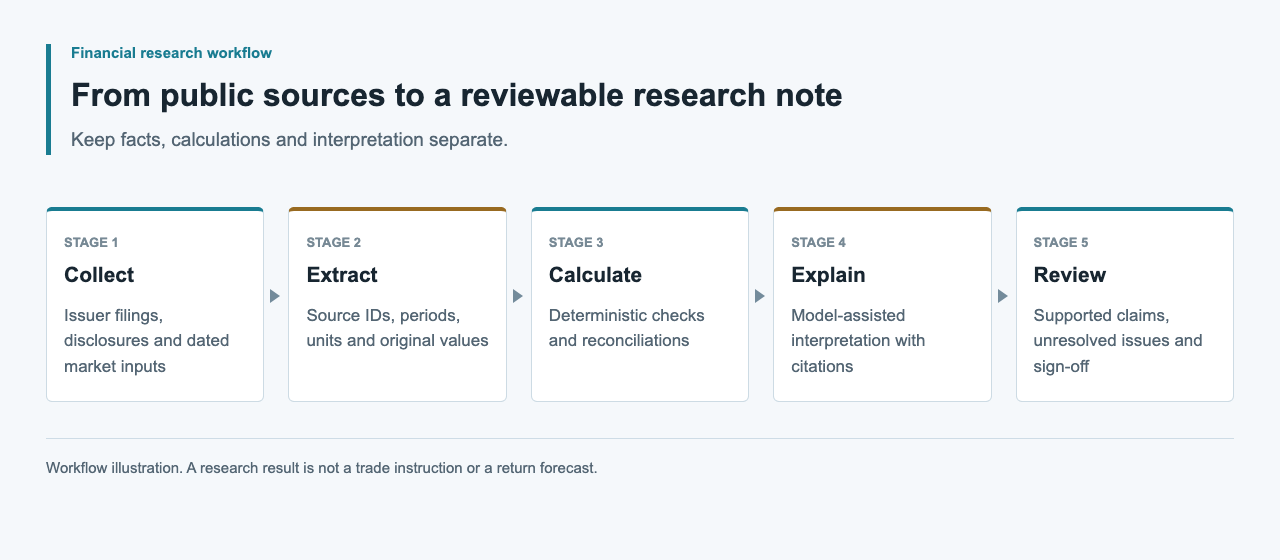
Start with a question such as whether reported margin changes are consistent with the company's disclosed operating drivers. Specify the issuer and information cutoff, collect comparable filings, calculate the changes and ask the model for explanations linked to those inputs. Define the output before collection: reported facts, calculated metrics, plausible drivers and unresolved questions. This gives a reviewer a concrete way to assess the result and helps you decide which additional source would improve the analysis rather than collecting an unlimited pile of company material.
Resolve the issuer and the information cutoff
Use stable issuer identifiers as well as the exchange-specific ticker. Record the security type, trading currency, reporting currency and fiscal calendar. An issuer's annual report, a local share price and a US depositary receipt can all describe related but nonidentical objects. Define whether the question concerns the business or a specific security. The cutoff is the latest information allowed into the research, not simply the end of the accounting period. Later restatements should be stored as new evidence versions rather than silently replacing earlier inputs.
Collect a source packet before requesting synthesis
Begin with issuer disclosures, relevant regulator filings and licensed supporting material. SEC submissions and XBRL interfaces can help with US filers, but they do not replace local-market disclosure sources or the original filing context. Keep the source URL, retrieval timestamp, document hash and section locator with every extracted item. A transcript is evidence of what a speaker said; a market quote is evidence of a price at a time; neither automatically verifies the other's claims. Require a clear reason for including each source in the packet.
| Evidence | Identity to retain | Typical mismatch |
|---|---|---|
| Filing | Issuer, accession or document version, period | Restated versus originally reported figures |
| Market series | Instrument, timezone, adjustment policy | Wrong share class or currency |
| Earnings call | Event date, speaker, transcript revision | Guidance treated as realized performance |
| Calculation | Input references and formula version | Mixed units or periods |
Calculate first, then ask for explanation
Compute changes and ratios using code or an audited spreadsheet, preserving input references and denominator rules. Send those results with the relevant source passages to the model. Ask it to explain plausible drivers, identify contradictions and list what remains unproven. For example, supply the revenue and margin calculations together with the segment note, then request a table mapping each proposed driver to supporting passages. Choose a current model according to the required context and output behavior. Keep the calculation record separate so a narrative revision cannot silently change its inputs.
Use a structured report contract
Separate reported facts, computed metrics, interpretations and unknowns. Every material interpretation should point to its supporting facts and acknowledge plausible alternatives. Use empty collections for unavailable evidence rather than invented examples that look like real financial results. The schema sketch below is an application-level design, not a new APIsRouter request format or an service project configuration. Your validator should reject missing source references and leave the artifact pending until a human has reviewed the reasoning.
{
  "issuer_id": "REQUIRED",
  "as_of": "REQUIRED_ISO_TIMESTAMP",
  "question": "REQUIRED_RESEARCH_QUESTION",
  "facts": [],
  "computed_metrics": [],
  "interpretations": [],
  "counterevidence": [],
  "unknowns": [],
  "review_status": "pending"
}
Review claims, not just citation formatting
Open the cited passage and check that it supports the specific sentence. Confirm the period, unit and company match. Then ask whether the interpretation follows from the evidence or adds an unstated assumption. A second model can help locate inconsistencies, but it is not independent corroboration if it only sees the first model's summary. Give the reviewer the original source packet and a clear rejection rule. Preserve disagreement instead of automatically merging competing explanations into a confident consensus.
Record cost and failure evidence at each stage
Save collection, parsing, calculation and model stages separately so a failed table extraction does not force the entire job to restart. Track requests and billable retries by job and model identity, then reconcile usage with the current pricing contract. Record unresolved usage as unknown. If a source is unavailable, return a partial research status with the missing evidence identified. A long, complete-looking report should not be treated as successful when its central claim rests on an omitted filing or an unverified numerical assumption.
Evidence and model access
This guide provides a source-backed workflow and illustrative output structure, not an executed company case. A complete case needs permitted inputs, source and code versions, actual model identity, usage records and reviewed claims. GPT-6 Astra officially exists, but the September 5, 2026 public APIsRouter catalog check did not list it. Use the current catalog to select a model for this workflow; official model access and gateway availability are separate.
FAQ
Can a model analyze a stock from its ticker alone?
It can generate prose, but an auditable analysis requires issuer identity, a cutoff, actual sources and a defined research question.
Should the LLM calculate financial ratios?
Use reproducible computation for material metrics and pass the result with its inputs to the model for explanation and review.
Does a valid citation prove the conclusion?
No. The passage must support the exact claim, and the interpretation must still be reviewed for assumptions and missing alternatives.
How do I select a model for this task?
Check source-packet size, required output structure and any tool interactions, then compare candidate models on the same reviewed task packet.
What is the best next step after one company report?
Establish source-version handling, partial-result states and claim review before expanding to a repeatable watchlist workflow.