AI stock trading systems
Updated 2026-09-05
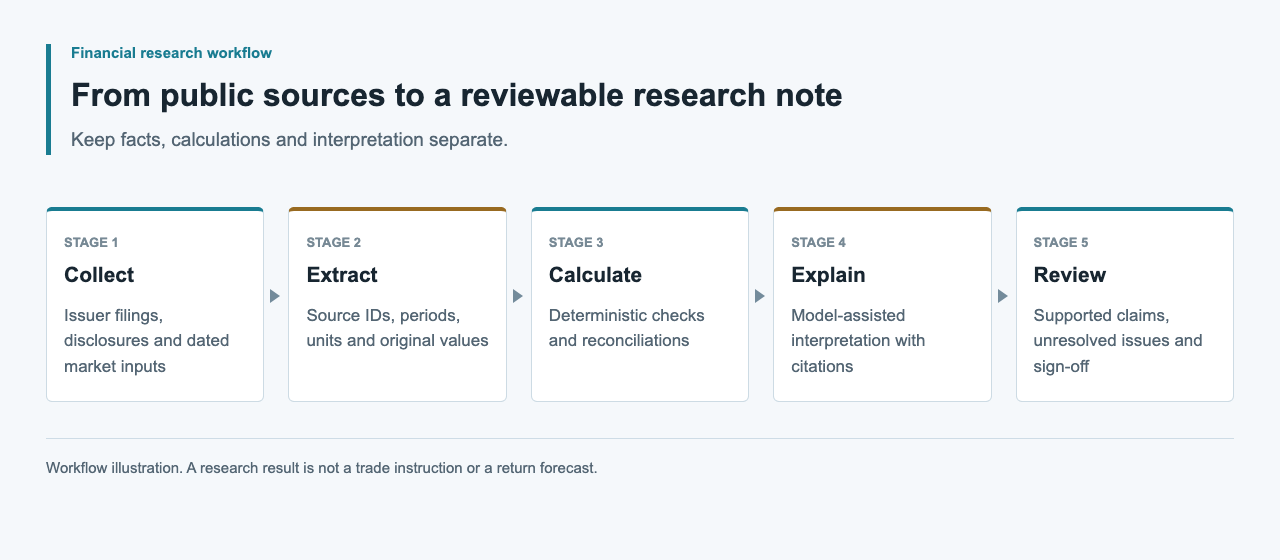
Research, quantitative evaluation and execution solve different problems. Build an evidence trail between them before treating an agent output as an actionable instruction.
Separate three meanings of an AI trading system
Decide whether you are building research, evaluating a strategy or operating an execution system. For research, start with a source-linked report. For strategy evaluation, define rules and a point-in-time dataset. For execution, specify authorization and order-state handling before granting access. A model-generated explanation is a hypothesis; a backtest is an experiment under assumptions; an order is an external action with financial consequences. Keeping these outputs distinct helps you choose the right project and prevents a successful step in one layer from obscuring a missing step in another.
Define the contract between each layer
Keep the boundary visible even when one application packages several layers together. The research stage should return structured observations and unresolved items. The evaluation stage should consume explicit rules, data versions and assumptions. The execution stage should accept only authorized instructions under independently enforced constraints. Avoid letting a missing source turn into an implicit neutral signal or a generated confidence number become a position size. These are domain decisions that need documented ownership.
| Layer | Output | What completion does not prove |
|---|---|---|
| LLM research | Sourced hypothesis or report | Predictive value |
| Strategy evaluation | Reproducible experiment | Future returns or live fills |
| Paper execution | Simulated order lifecycle | Real liquidity and operational safety |
| Live execution | Authorized order and reconciliation | Ongoing strategy validity |
Use LLMs for bounded research tasks
Language models can compare disclosures, draft analysis code and explain experiment logs. Give each task a known source packet and require references in its output. For code assistance, supply the experiment specification and expected data schema, then review the generated code before execution. Keep financial-data credentials separate from model credentials and make research tools read-only by default. An article or filing received through retrieval must never acquire authority to change execution permissions. These boundaries make a research application easier to debug without coupling every model request to a trading system.
Distinguish Qlib experiments from FinRL training
Qlib provides a quantitative workflow with data preparation, model training and evaluation. FinRL studies reinforcement-learning policies in market environments. Neither core workflow is a general chat endpoint. An LLM may suggest a factor or edit experiment code around them, but the actual calculations consume local or hosted compute resources and depend on their datasets. Choose a framework according to the hypothesis being evaluated. Do not compare an agent's written argument with a reinforcement-learning reward as though they were measurements of the same outcome.
Audit information availability and execution assumptions
A historical date in a prompt is not a point-in-time data guarantee. Record when disclosures became public, how revisions are handled, and which securities existed in the universe at the time. For international markets, confirm the trading calendar, share-class mapping and currency treatment. Evaluation assumptions must also cover commissions, spreads, slippage, liquidity and applicable market constraints. If those inputs are unavailable, report the evaluation boundary. Changing assumptions after seeing a favorable curve can make a reproducible calculation misleading even when the code contains no obvious error.
Keep permissions and risk checks outside generated prose
A research report should not be able to grant itself trading permissions. A later execution system needs explicit ownership for authorization, position limits, duplicate detection, cancellation and reconciliation. Enforce those controls in code and service permissions rather than in a prompt alone. Preserve the distinction between an analyst approving a research artifact and a person authorizing an order. A warning label at the bottom of a report does not compensate for an agent having unnecessary broker credentials in its environment.
{
  "mode": "research",
  "data_access": "read_only",
  "order_submission": "disabled",
  "artifact_review": "required",
  "missing_required_data": "stop",
  "evaluation_status": "not_run"
}
Measure system reliability independently of returns
Before evaluating a strategy, verify whether jobs finish with the intended sources, whether failures are surfaced, and whether results can be reproduced from saved inputs. Record source coverage, rejected outputs and unresolved billing rather than inventing a success rate. Paper execution adds tests for order-state transitions but does not recreate every live-market condition. A passing client smoke establishes only connectivity through that client. Maintain separate evidence for model calls, complete research, historical evaluation and any later execution environment.
Use a bounded evaluation budget
Limit the number of candidate strategies, model iterations and retry attempts before a run. Agent-generated code can otherwise create an open-ended search over the same evaluation data. Preserve failed hypotheses and the reason each candidate was rejected. Count data, compute and analyst review alongside model charges, using the current model contract rather than a fixed price copied into an article. A credible comparison reports what was attempted and what remains unknown. Investor.gov's AI fraud guidance is a useful reminder that guaranteed-performance language is a warning sign, not evidence.
Evidence and scope
This comparison uses official framework documentation and describes system design. It contains no executed strategy, paper-trading result or live trading case. Any later performance claim needs its own dataset, experiment and execution evidence, with assumptions and review boundaries disclosed.
FAQ
Can a research agent submit trades?
Only if a separate integration grants that capability. This workflow keeps orders disabled and does not provide execution setup instructions.
Is paper trading enough to approve live trading?
It provides simulation evidence, not a complete account of live liquidity, failure handling or financial risk. Operational and strategy reviews remain necessary.
Where does an LLM API belong?
In bounded text analysis, tool coordination or code assistance. Market-data acquisition, quantitative calculation and order authorization retain separate contracts.
Why preserve unsuccessful experiments?
They reveal the search process and prevent a selected favorable result from being presented as the outcome of a single predefined test.
Which project category fits a first prototype?
For a sourced report, evaluate a research application. For a numerical hypothesis, begin with a quantitative framework and a small reviewed dataset before adding an LLM loop.