AI stock watchlist research agent
Updated 2026-09-05
Monitor a defined research universe for meaningful source changes, update evidence-linked notes and send reviewable notifications without repeating unchanged reports.
Define what counts as a meaningful update
A watchlist agent should answer what changed since the last reviewed research packet. Define the events that matter: a new filing, a corrected disclosure, an earnings call or evidence affecting an open research question. Store each issuer's research questions and source coverage alongside its identifier. This gives the model a bounded job and gives the reviewer a reason for receiving an update. Avoid scheduling unrestricted company analysis merely because a timer fired; unchanged inputs should normally produce an unchanged state rather than another lengthy report.
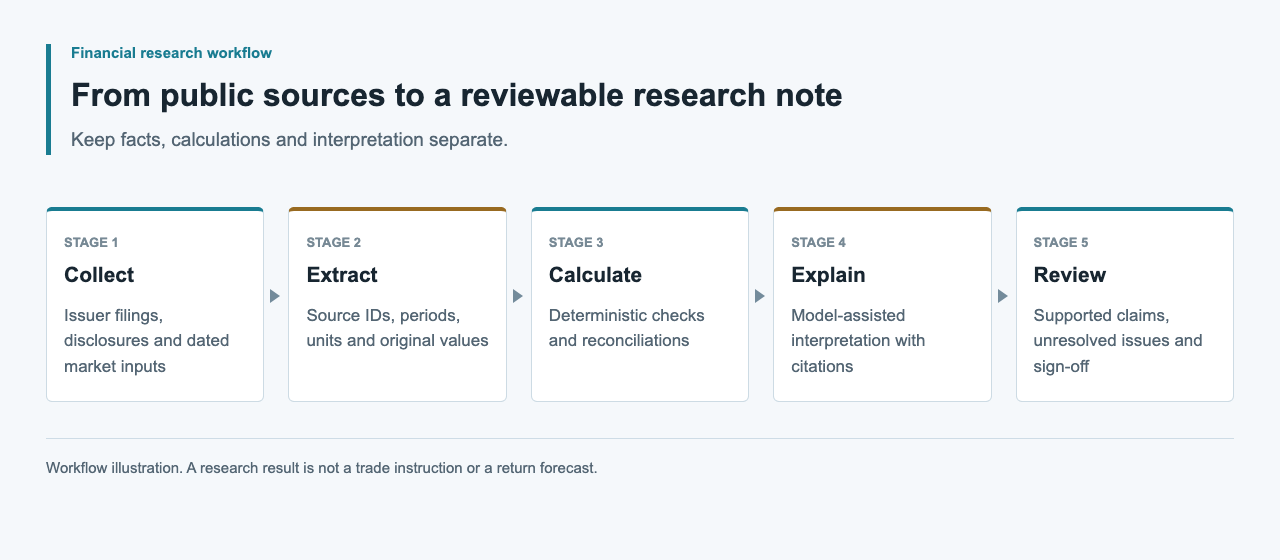
Separate collection from research generation
Use source feeds or permitted polling to collect metadata first, then decide whether new material warrants model work. SEC developer resources describe filing feeds and indexes that can support US-filer collection; other markets need their own authoritative sources. Store publication time, retrieval time and source revision independently. A changed webpage wrapper should not be mistaken for a new company disclosure. Build content identity from the relevant document or event, and retain source errors separately from the determination that nothing changed.
Schedule by market and source, not one global clock
Keep the exchange timezone and holiday calendar with each security. Use disclosure timestamps for information availability and a separate schedule for when reviewers want the summary. An issuer can publish outside market hours or list in multiple markets. Do not shift every event to a single calendar date and lose the ordering. For recurring jobs, record the intended window and actual execution time. A missed run should resume from the last completed collection watermark rather than silently skipping an interval or replaying an entire history.
Use explicit job and notification states
A small state machine makes recurring work easier to operate. Distinguish unchanged, new evidence, source unavailable, research pending and review required. The illustrative record below is an application design, not a scheduler product configuration. Keep a stable event key and a source-manifest hash so retrying the same job does not generate duplicate work or duplicate notifications. Persist the artifact before marking the event complete. Notification delivery should have its own acknowledgment state instead of being inferred from successful report generation.
{
  "issuer_id": "REQUIRED",
  "event_key": "REQUIRED_STABLE_KEY",
  "source_manifest_hash": "REQUIRED",
  "collection_status": "pending",
  "research_status": "not_started",
  "review_status": "pending",
  "notification_status": "not_sent"
}
Generate a change note from the current and prior packet
Supply the model with the new source, the previous reviewed note and the open questions. Ask for a short change log with source locators and a clear explanation of which prior statements need updating. Preserve the original note as a revision rather than overwriting it. A new disclosure can strengthen, weaken or leave an interpretation unchanged; do not force every event into a directional stock signal. If the previous packet is missing, produce an initial research state rather than inventing a historical comparison.
| Observed condition | Research action | Notification |
|---|---|---|
| Same source identity | Retain current packet | Usually none |
| New relevant disclosure | Create a sourced change note | After review policy passes |
| Corrected disclosure | Revise affected claims | Identify the correction |
| Source unavailable | Retain last known state with freshness warning | Escalate according to impact |
| Budget exhausted | Leave queued work visible | Request attention if required |
Bound the recurring budget and retry policy
Set per-run limits for issuers, source volume, model attempts and wall-clock work before scheduling. Use the current model contract for planning and retain actual usage by event and job. Separate source retries from model retries so a temporary filing outage does not trigger repeated analysis of stale data. Cache extraction using document and parser versions. Stop generating new work when the budget is exhausted, preserve queued events and surface the unresolved state. Keep notification frequency independent from collection frequency to reduce unnecessary review load.
Exercise a small operational miniflow
Before enabling recurring delivery, test an unchanged document, a new revision, a temporarily unavailable source and a retried notification. Verify stable event identity, correct research status and exactly one intended notification for the same completed event. Then inspect one complete change note against the original evidence. Keep the collector and research tools read-only, and use explicit authorization for external messaging destinations. Research approval is not order approval; the watchlist workflow should not gain broker permissions simply because it runs unattended.
Evidence and limitations
This guide is a workflow design informed by official filing resources and source-reviewed research applications. No recurring watchlist job, notification delivery or measured usage case was executed for this page. A deployment record should identify the actual scheduler, source coverage, model, persisted event states and notification test before claiming the recurring workflow is operational.
FAQ
Should the agent send a report on every run?
Usually not. Separate source collection from meaningful-change detection and notify according to the review policy, not simply the timer frequency.
How do I prevent duplicate notifications?
Use a stable event identity, persist the completed artifact and track notification delivery independently so retries can detect already handled events.
What happens when a financial source is unavailable?
Preserve a source-unavailable state and the freshness of the last known packet. Do not reinterpret missing data as no change.
Can one schedule handle every exchange?
A scheduler can coordinate them, but the workflow still needs market-specific calendars, timezones and disclosure timing.
Does this page create an automation?
No. It explains the architecture and acceptance checks. Configure and authorize the actual scheduler and notification destinations in your own environment.