AI earnings call analysis
Updated 2026-09-05
Turn a transcript into a source-linked record of guidance, explanations, analyst questions and unresolved issues. Compare like-for-like statements across calls.
Choose the comparison before summarizing the call
Decide whether you need a single-call brief, a change in guidance or a comparison of management's explanation across periods. Each requires a different source set. For a guidance comparison, collect both calls and the relevant earnings releases. Write the reporting periods and information cutoff into the task. A useful output records what changed, who said it and where the evidence appears. Avoid asking for a single bullish or bearish label that hides the topic-specific differences an analyst actually needs to review.
Use an attributable transcript and keep its rights
Prefer an issuer-hosted transcript or a properly licensed provider copy. Microsoft's official FY25 fourth-quarter event page is an example of an issuer publishing call materials; it is a source-location example, not an analysis result reproduced here. Record the event date, transcript version, original language and URL. If you create a transcript from audio, retain timestamps and flag uncertain words or speaker assignments. Permission to listen does not automatically grant permission to redistribute the full transcript, so check usage rights before storing or publishing derived packets.
Segment by speaker and conversation context
Keep prepared remarks, questions and answers distinguishable. A question about demand is not a management disclosure that demand changed. Preserve the relationship between a question and the answer that follows, including qualifications. Segment long text by coherent topic rather than arbitrary length alone. Carry source offsets or timestamps into each chunk, and keep a neighboring passage available for review. For multilingual calls, retain the original alongside any translation so a reviewer can inspect terms whose financial meaning may shift between languages.
| Segment | Preserve | Common analytical error |
|---|---|---|
| Prepared remarks | Speaker and reporting context | Treating promotional language as an audited fact |
| Analyst question | Questioner and requested clarification | Attributing the question to management |
| Management answer | Qualifications and source locator | Dropping conditions from guidance |
| Translated passage | Original wording and translator identity | Changing the strength of a forecast |
Extract claims before asking for a narrative
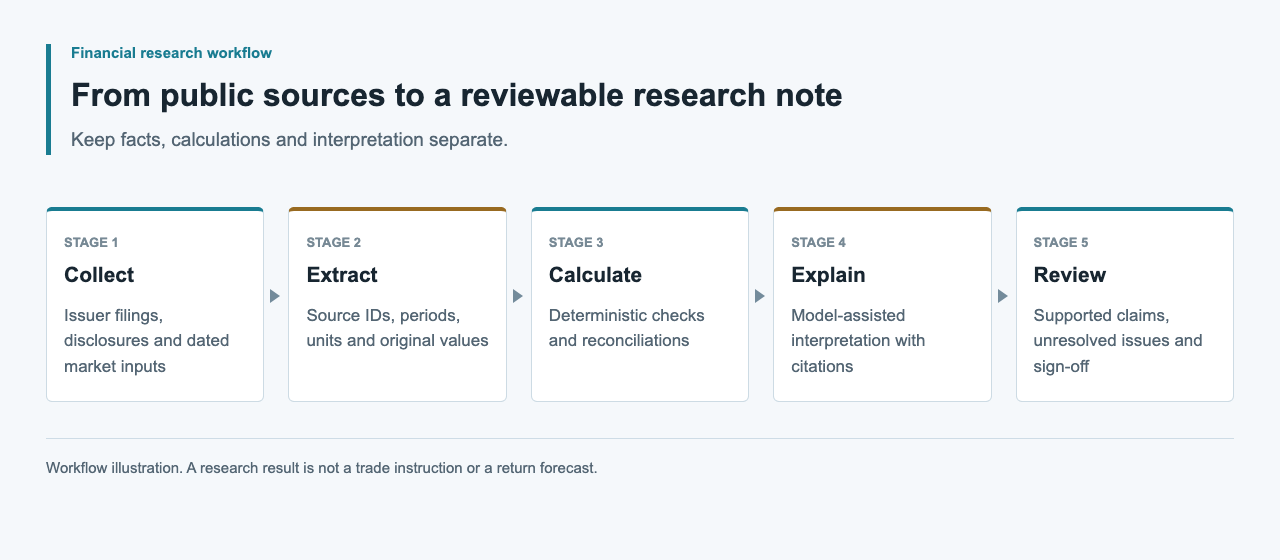
Create a claim table with speaker, topic, claim type, period and locator. Distinguish realized results, forward-looking guidance, qualitative explanations and unanswered questions. The illustrative output structure below leaves evidence empty rather than inventing a financial statement. Your application should require every populated claim to reference a real source segment. Once extraction is reviewed, ask the model to draft a concise narrative from those records. This sequence makes it easier to correct a mistaken attribution without rebuilding the entire report.
{
  "event_id": "REQUIRED",
  "transcript_version": "REQUIRED",
  "claims": [],
  "guidance_changes": [],
  "unanswered_questions": [],
  "cross_checks": [],
  "review_status": "pending"
}
Compare guidance on the same measurement basis
Before declaring that guidance increased or decreased, align the metric, period, currency basis and scope. A constant-currency statement and a reported-currency statement are not interchangeable. Compare a range with a range using a documented rule, and keep management's conditions attached. Cross-check quantitative claims against the earnings release or relevant filing. A model can propose the alignment, but code or a reviewer should validate the comparison. If the metric definition changed, describe the change in definition instead of forcing a numeric comparison.
Write the brief around evidence and open questions
Organize the output by important business topics, then show the current statement, prior statement, source locators and interpretation. Include areas where the call offers insufficient evidence. Distinguish what management asserted from what other documents corroborate. A transcript alone does not establish whether an explanation is correct. Avoid converting confident language, sentiment scores or the number of repeated phrases into a claim about future returns. The most useful follow-up often is a specific question to test in a filing, operating metric or later disclosure.
Run quality checks and manage repeated calls
Check speaker attribution, quotation accuracy, numerical consistency and source accessibility before approval. Preserve rejected extractions and manual corrections. For recurring analysis, cache segmentation by transcript hash and compare only genuinely new or revised claims. Keep model requests, transcription work, data licensing and analyst review in the task ledger. Limit automatic retries and return partial status when essential segments are unavailable. A watchlist workflow can then notify reviewers about a meaningful change instead of issuing a new generic summary every time a job runs.
Evidence and limitations
This page provides a source-backed method and an illustrative output structure. It does not present an executed earnings-call case, measured sentiment accuracy or APIsRouter task cost. The linked issuer page demonstrates an official source location. A complete case should preserve the licensed transcript, extraction records, cross-checks, actual model identity and human review before publishing conclusions.
FAQ
Should analyst questions be treated as company facts?
No. Preserve the questioner and distinguish the question from management responses and independently verified disclosures.
Can I compare translated calls directly?
Retain the originals and review material financial terms. Translation can change qualifications or measurement language that matters to a comparison.
How should guidance ranges be compared?
Align metric, period, scope and currency basis first, then use a documented comparison rule while keeping the original ranges and conditions.
Does positive language imply future stock performance?
No. Tone is a textual observation. Any proposed predictive relationship needs independent evaluation beyond the transcript analysis.
What makes a call summary reviewable?
Speaker and source locators, a clear distinction between results and forecasts, cross-checks against disclosures, unresolved items and an approval record.