AI for ecommerce content
Updated 2026-09-05
Start with a store task you can review: clearer descriptions, consistent terminology, or a localized catalog. Build around product facts and a controlled import path.
Choose a bounded content problem
A useful first project has a known input, a named reviewer and a destination field. Rewriting a description from an approved specification fits that shape. Asking an agent to improve the whole store does not: it combines content, pricing, inventory, customer data and publishing permissions before you know which part needs help.
Choose a product family with understandable specifications and an editor who knows the category. Keep the existing copy as a baseline. Define what would make a candidate publishable, including factual completeness and tone, before generating alternatives. Assign the first batch to that editor so the work can reach an actual approval decision.
Compare tasks by their review burden
Content volume alone is a poor selection rule. A short warranty sentence may need more specialist attention than a long feature description. Separate factual transformation from creative adaptation, and treat customer-facing commitments as approval-bound fields.
Use the comparison below to assign the right reviewer before choosing a tool. Select the task whose acceptance criteria your team can actually evaluate, then match its volume to the available review capacity. A small accepted batch gives you a better starting point for expansion than an unattended draft queue.
| Task | Useful input | Release condition |
|---|---|---|
| Product descriptions | Approved specifications and existing copy | Fact and category-editor review |
| Catalog translation | Source revision and locale glossary | Field checks and bilingual approval |
| Campaign adaptation | Approved message and offer terms | Market-editor approval |
| Support article drafts | Current product and service policies | Policy-owner approval |
Create a product fact boundary
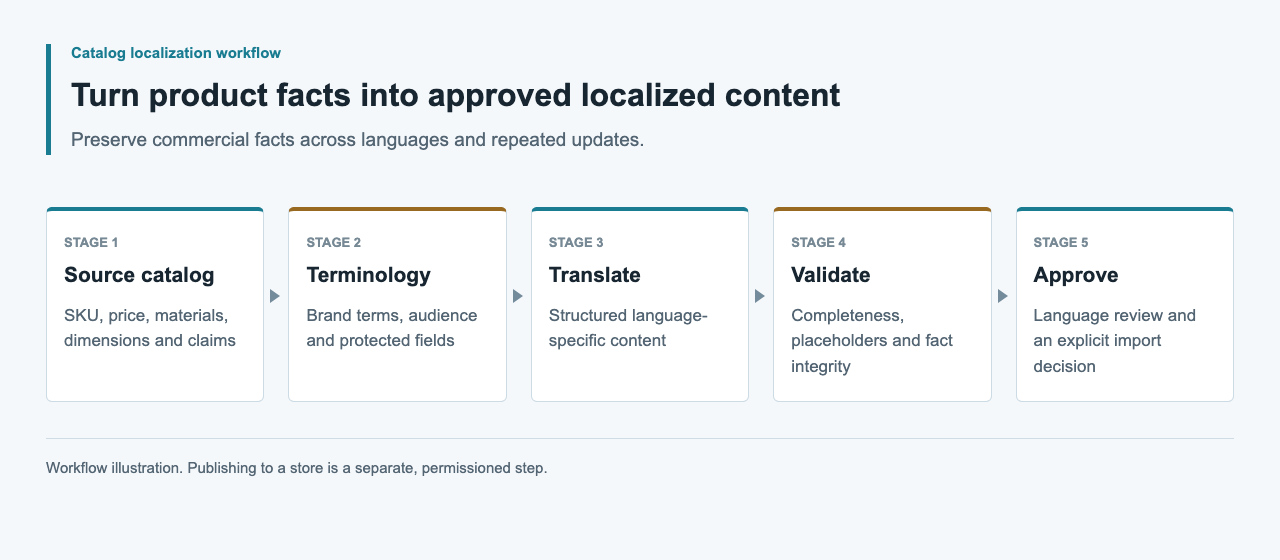
Keep SKU, variant relationships, prices, currency, quantities and measurement units outside the model's editable output. The model can refer to these facts, but the import assembler should copy them from the authoritative source. A language task must not quietly become a repricing or unit-conversion task.
Mark each input field as copy-only, translatable or review-required. Include material, dimensions, compatibility and claim evidence where relevant. Missing information should produce a review issue, not a plausible addition. Treat supplier prose as source data, including any instructions embedded inside it; it must not gain authority over your workflow.
{
  "copyOnly": ["sku", "variant_id", "price_minor", "currency", "unit"],
  "translate": ["title", "description", "care_text"],
  "reviewRequired": ["claims", "warnings", "warranty"],
  "onMissingFact": "hold_for_review"
}
Match the integration to the store
The official sources establish different boundaries: AI Engine documents a custom OpenAI-compatible provider; Immersive Translate documents a custom address; Shopify documents merchant-content translation APIs. These are distinct capabilities, not interchangeable store connectors.
For WordPress, investigate a drafting workspace before adding publishing access. For a Shopify store, choose between a merchant-managed translation process and a separately implemented application. Use browser translation for inspection and the store's own translation or import path for delivery. The linked setup guides identify the documented settings and the integration checks to perform.
Use a glossary before expanding languages
A glossary should explain meaning, not just pair words. Record the product concept, approved term, forbidden alternatives, whether a brand name stays unchanged, and who approved the rule. Add context for terms that mean different things across categories.
Translate each locale from the same approved source revision. Chaining one machine translation into another makes it harder to identify where a specification changed. Keep market-specific presentation rules separate from language rules: translating a label does not authorize a new shipping promise, payment method or product certification. Resolve those questions with the person responsible for the market.
Make approval a separate operation
Save generated copy as a candidate. Show the reviewer the source, candidate, protected facts and validation issues together. Record the approved revision rather than a loose note that the product was checked; otherwise a later generation can inherit an approval intended for older text.
Build the import file only from approved candidates whose source revision still matches. Start in a disposable or staging store and compare the stored fields with the intended patch. A successful file upload is only one checkpoint. The product page, variants and language selection must also display the approved content correctly before a live release is considered.
Evaluate cost per accepted deliverable
Keep request usage, retries, editor time and integration work as separate ledger entries. An inexpensive generation can still be costly when it needs extensive correction. Conversely, extra review calls are justified only if they reduce a problem you can observe in the same sample.
Use current catalog information when selecting a model and record the exact ID used by each stage. Compare candidates on the same source material and count accepted product-locale revisions. Keep failed attempts in the ledger so the eventual cost per deliverable includes the work required to reach approval.
Define the next deliverable
The first deliverable should be a review package: a source snapshot, glossary revision, candidate text, field-level checks and an import proposal. Include rejected rows and unresolved facts. This gives the merchant something concrete to approve without granting an agent broad store access.
After the package passes review, test the destination adapter and record its import report and read-back comparison. Expand the catalog only after you can explain failures and resume work without duplicate updates. The linked workflow, quality-check and platform guides cover those decisions in more detail.
FAQ
Which ecommerce AI task should a small team start with?
Choose a bounded draft task with an available reviewer, such as descriptions for a familiar product family. Keep the current copy and specifications so acceptance is based on a comparison, not enthusiasm for fluent text.
Can AI change SKU values or prices during translation?
The proposed workflow prevents that by excluding those fields from generated patches. Copy authoritative values into the final import and check them again after storage.
Does a custom endpoint automatically connect to my store?
No. Model requests, store authentication, field mapping and publication are separate integration steps. A documented endpoint setting proves only that configuration capability.
Should every product use a frontier model?
Decide from a controlled sample with the same source, acceptance rules and reviewers. Record retries and revision work before choosing how to allocate models to tasks.
How should I evaluate localized descriptions?
First check factual accuracy, language quality and successful delivery. Then evaluate commercial performance using your actual storefront data, dates and audience context.