AI game development API cost
Updated 2026-09-05
Budget the route to an accepted playable slice. Track text coding, image production, failed repairs, and human work separately so the total explains what was achieved.
Estimate the workflow, not the initial prompt
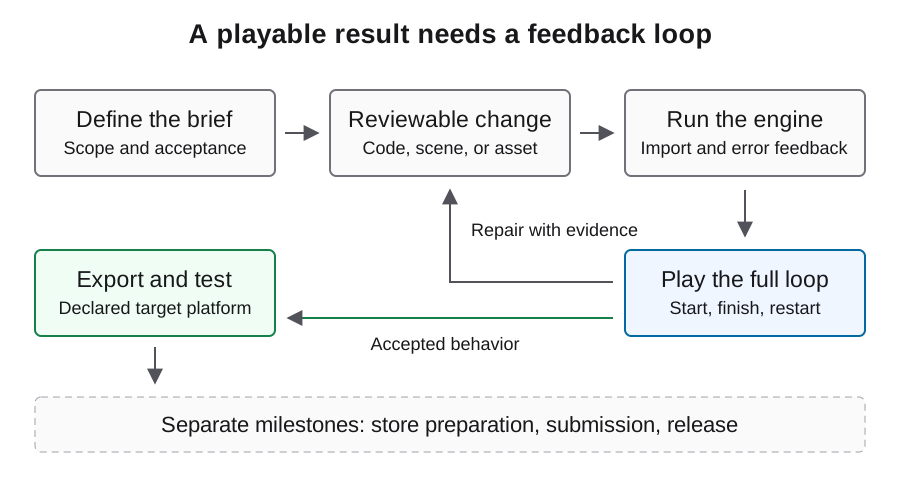
A game-development session can repeatedly read source, propose edits, interpret engine errors, inspect screenshots, and retry failed work. The initial brief is only one input. Start budgeting with a small accepted milestone, such as a complete round and restart, rather than assuming a single request will produce a deliverable.
List the stages you expect to pay for: implementation, debugging, asset work, localization, and review. Mark which run locally and which invoke a billable service. Use a pilot to learn where usage accumulates before approving a larger budget; an estimate should describe its assumptions rather than resemble a measured invoice.
Keep separate ledgers for separate resources
Use distinct categories for text-model calls, image generation, audio services, local engine work, and human intervention. A local compile does not inherently consume model tokens, while sending its log back to an agent can create another request. One assistant may orchestrate all of these activities without making their billing units identical.
Keep subscription activity separate from API usage. If you allocate part of a subscription to a project for internal budgeting, label it as an allocation rule, not an observed per-request charge. Likewise, do not count a development task's API spend as a cost incurred by every future player of an offline game.
| Category | Record | Budget question |
|---|---|---|
| Text coding | Provider usage and actual model identity | Which repair stage consumes requests? |
| Image or audio production | Service-specific request and billing records | How many outputs reach acceptance? |
| Engine work | Local execution time and environment | Where does build or import work block progress? |
| Human review | Interventions and review time | What still needs manual correction? |
Capture request records before aggregating
Assign a run identifier and stage to each operation. Preserve provider request identifiers where exposed, actual model identity, outcome, usage, and a reference to the billing evidence. Sanitize credentials before exporting logs. The illustrative record below deliberately leaves unobserved values null.
Do not infer a successful request from an accepted local file, or a zero charge from a timeout. Some usage arrives after the client loses its connection. Reconcile the provider's record before finalizing the total and keep unmatched entries visible. This makes repeated experiments comparable without turning gaps in telemetry into apparent savings.
{
  "run_id": "game-pilot",
  "stage": "controller-repair",
  "provider_request_id": null,
  "model_id": null,
  "outcome": "not_started",
  "usage": null,
  "billed_amount": null,
  "currency": null,
  "billing_evidence": null,
  "accepted_artifact_hash": null
}
Apply the actual provider pricing contract
Use the provider and service tier that handled the request, with the rate schedule applicable to that billing record. OpenAI's official pricing describes token and tool categories; APIsRouter pricing is a separate commercial source. Neither should be silently substituted for the other.
For an estimate, multiply each billable category by its applicable rate and add service-specific charges. Check how the provider reports cached input, output, and tool usage so categories are not counted twice. Keep currency and conversion assumptions explicit. Prefer the provider's settled charge when reconciling actual spend, and retain the estimate separately so you can explain the difference.
Put stop conditions around repair loops
Set a budget ceiling and a checkpoint after each accepted milestone. Bound automatic retries and decide what symptom triggers human diagnosis, such as repeated edits that leave the same reproduction unchanged. A provider spending control and an agent task limit protect different boundaries; use both when available and verify how each behaves.
Reduce unnecessary context by sending the relevant scene, changed files, and first meaningful error. Preserve enough state to avoid repeating failed approaches. Do not remove important evidence just to shorten input: a cheaper request that produces another blind repair can increase the cost of the accepted result.
Compare models on the same acceptance path
Hold the brief, project baseline, target, and acceptance criteria constant. Record failed attempts and human assistance for each model. Compare total reconciled spend and accepted behavior, not just token price or the first response's apparent quality.
Assign different task categories only after a pilot shows they meet the required standard. Straightforward string handling, difficult gameplay diagnosis, and visual review may have different needs. A more capable model might reduce iterations, but that remains a hypothesis until the same-task record supports it. Avoid a rolling recommended-model list that becomes stale or implies unverified availability.
Separate game production from runtime economics
An offline exported game can use ordinary deterministic logic after development. If you add live model-generated dialogue or other runtime features, create a separate budget covering player behavior, service failures, abuse controls, and continuing operations. Keep secrets behind an appropriate service boundary instead of embedding a provider key in the game client.
Do not estimate that runtime budget by multiplying development tokens by sales. Measure the actual feature's request pattern in an authorized test and review the applicable platform requirements. Image assets generated once during production and images generated for players during runtime also belong to different cost models.
Evidence and the Astra case
The game prototype's model identity remains unverified until explicit Astra evidence is attached. Confirm the actual provider, access mode, and model identity before applying any rate to that case. Use the provider billing record rather than inferring a charge from the model named in the development brief.
There is no measured game budget on this page. Its ledger and budgeting steps are a method for obtaining one. A useful final report would state the accepted milestone, artifact identity, actual API spend, separate asset charges, human work, and unresolved billing entries so readers can judge what the expenditure accomplished.
FAQ
How much does one AI-built game cost?
There is no reliable universal number. Scope, repair loops, assets, access mode, and human review determine the workflow. Measure a small accepted slice first.
Should failed requests be excluded?
Keep them in the ledger and reconcile their billing outcome. A failed client operation does not necessarily imply zero provider usage.
Are image costs part of Astra text coding?
Record image-generation service charges separately. An agent coordinating the call does not make the image service and text model the same billable resource.
Is subscription usage the same as API cost?
No. Keep subscription activity and actual API charges separate. Any internal subscription allocation should be labeled with its accounting rule.
What metric is more useful than cost per prompt?
Total reconciled spend for an accepted milestone, accompanied by intervention and defect records. It connects expenditure to a result the player can use.