AI investing research workflows
Updated 2026-09-05
Start with the research result you need: a sourced company brief, a reproducible screen or a testable hypothesis. Then choose the data, software and model roles that can produce it.
Define the decision support you actually need
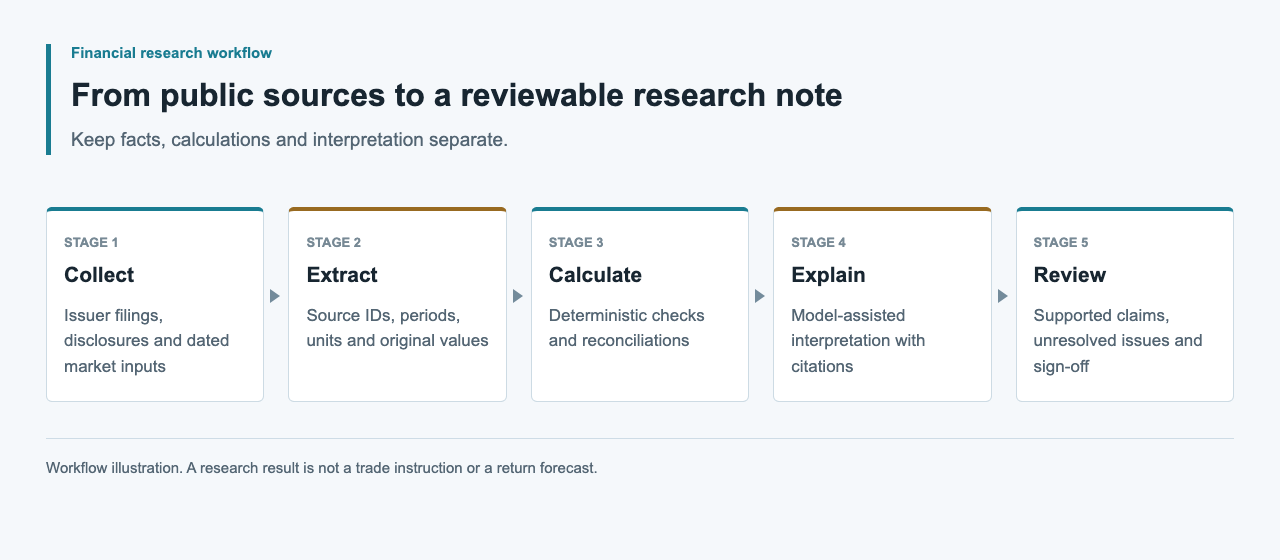
Start with one recurring research question and a deliverable someone can review. For example, explain changes in working capital across comparable reporting periods, with links to the underlying disclosures. Collect those statements, calculate the relevant changes and use the model to draft explanations and follow-up questions. AI investing also includes screening and quantitative experiments, but those need different tools. Choose the workflow that produces your next useful artifact, then expand only after its inputs and output are easy to inspect.
Match the research task to the right system
Choose software by its role in your process instead of assembling every finance repository into one stack. An LLM application can organize language and tool use; a data platform supplies licensed inputs; an experiment framework computes and records results. These responsibilities may coexist in a product but should remain distinguishable in your evidence. A comparison is useful when it tells you what must still be supplied and reviewed, not just what the project README promises.
| Task | Suitable starting point | Acceptance artifact |
|---|---|---|
| Read filings | Document pipeline with a research model | Claim-to-source table |
| Compare research arguments | TradingAgents or ai-hedge-fund | Reviewed arguments and missing evidence |
| Financial NLP application | A specific FinGPT notebook | Tool results and labeled text |
| Generate research experiments | RD-Agent plus Qlib | Code, data split and experiment record |
| Study reinforcement learning | FinRL environment | Training and evaluation records |
Build an international data contract
Identify the issuer, exchange, share class and research cutoff before collecting material. Reporting currency can differ from trading currency, and fiscal quarters need not align with calendar quarters. Keep local exchange disclosures and issuer investor-relations pages available even when a US filing exists. A depositary receipt may need an explicit ratio before per-share comparisons make sense. Store source publication time, retrieval time and revision identity. These fields make the research portable across markets without pretending that one market-data provider covers every instrument or accounting convention.
Give models evidence and bounded roles
Extract permitted source material and compute financial metrics before requesting model synthesis. Give an extraction reviewer the original table and parsed cells; give a research model the accepted metrics and relevant passages. Ask each role for a specific output instead of a general opinion. Choose current model IDs according to the required context, tool and output behavior. Keep order tools outside the research application, and treat retrieved documents as evidence rather than instructions to change system settings. Preserve the original packet so a reviewer can trace a short summary back to its context.
Require a claim ledger, not just a polished report
For each material conclusion, retain the source locator, relevant period, calculation reference and whether it is a reported fact, an assumption or an interpretation. A report should also state what evidence would weaken its central explanation. Missing material should appear as an unresolved item with an owner, not disappear during summarization. Review a few difficult claims against original documents before increasing coverage. A high citation count is not enough: a valid-looking link can still point to a different period or fail to support the sentence beside it.
{
  "issuer_id": "REQUIRED",
  "research_cutoff": "REQUIRED_ISO_TIMESTAMP",
  "source_manifest": [],
  "reported_facts": [],
  "calculation_refs": [],
  "interpretations": [],
  "unresolved_items": [],
  "review_status": "pending"
}
Separate experiment completion from evidence of value
An imported library, a client response, a completed agent graph and a reviewed research report establish progressively different things. Strategy validity needs additional evidence, including point-in-time inputs and evaluation outside the period used to tune the process. Save unsuccessful experiments as well as accepted outputs. Otherwise the apparent quality reflects selection after the fact. If a workflow cannot explain which source version it used, do not use its historical results as evidence for a model comparison or an investment decision.
Budget the accepted research output
Estimate the whole task: model requests, retrieval, financial-data access, local computation and human review. Multi-agent coordination can repeat the same document context many times. Start with a bounded source packet and a maximum number of iterations, then measure actual usage rather than publishing an assumed average. Keep unsuccessful requests in the ledger where they incurred charges. Compare models on accepted outputs under the same task conditions. A lower token price is not automatically a lower research cost when extraction errors or repeated review consume more work.
Choose a first project with a clear stopping rule
Begin with one company and a narrow question that a human can audit. Stop the job if required filings are missing, a numerical reconciliation fails or the budget is exhausted. Expand to a watchlist after you can preserve source identity, resume a failed stage and review the final artifact. Choose TradingAgents for a multi-role research experiment, a FinGPT application for financial NLP, or RD-Agent with Qlib for a code-and-evaluation workflow. Investor.gov warns about fraudulent investment claims using AI branding; use inspectable evidence and appropriate professional review when evaluating an investment-related service.
Evidence and scope
The linked official sources support the project roles and research methods described here. The examples are workflow designs, not executed investment cases. No model-performance, task-cost or stock-return result is claimed. For your own pilot, preserve the source packet, configuration, actual usage and reviewed artifact together.
FAQ
What is the most useful first AI investing task?
Choose a narrow evidence-review task, such as comparing two reporting periods. It is easier to validate than an unrestricted recommendation and establishes reusable data discipline.
Is an AI investing agent the same as a trading bot?
No. Research agents organize evidence. Strategy evaluation and order execution have different data, permission and operational requirements.
Do Qlib and FinRL consume chat tokens?
Their core training and evaluation work is local computation. An attached LLM agent may consume API tokens, but that is a separate component.
Can one provider cover all international stocks?
Do not assume it. Check instrument identifiers, exchanges, disclosure coverage, currencies, update history and licensing for your actual universe.
How do I decide whether a pilot was useful?
Review whether it answered the predefined question with correct sources, reproducible calculations and fewer unresolved steps in your actual research process.