AI investing tools
Updated 2026-09-06
Compare hosted software, local research environments and bring-your-own-key applications by the work they save and the evidence they let you inspect.
Choose software around your recurring work
Write down the task you perform repeatedly and the artifact someone must review afterward. A filings analyst may need reliable table extraction and citations. A watchlist owner may need source-change detection and quiet handling of unchanged companies. A quantitative researcher may need reproducible experiments. Those needs lead to different tools. Avoid choosing an application solely because it offers many agents or a prominent model name. Ask what you can export, what you can reproduce and what happens when a required source is missing.
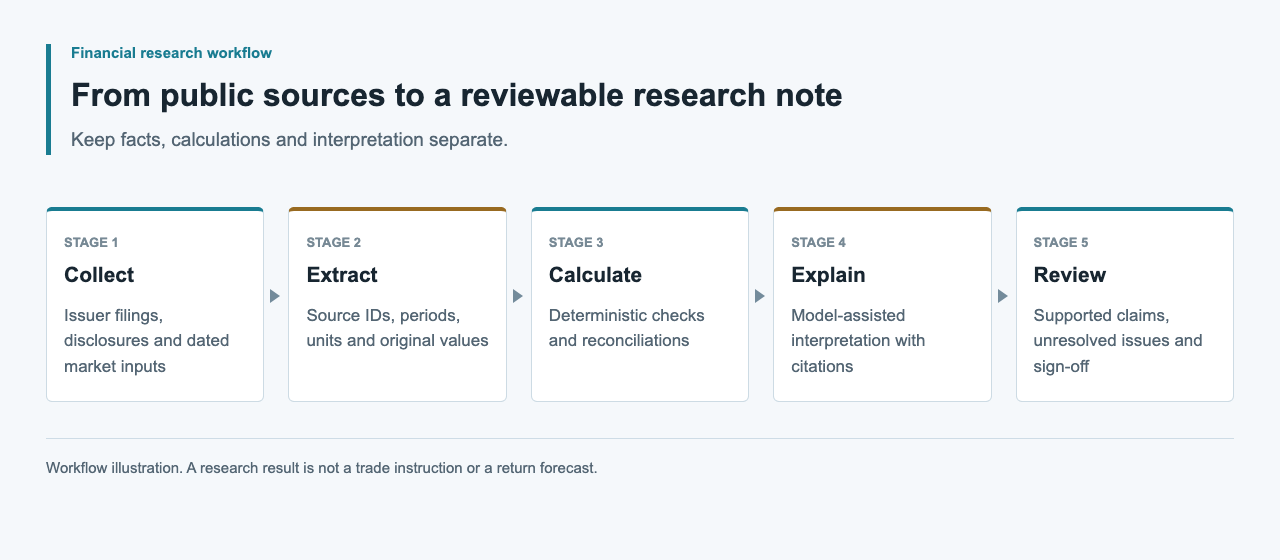
Compare hosted, local and BYOK operating models
Hosted software can reduce environment maintenance but may constrain data access and export. Local applications provide direct control over files and execution, with more responsibility for dependencies and updates. BYOK applications let you supply a model credential, but may still send material to multiple data or model services. These categories overlap: a local interface can call a remote model, and a hosted workspace can accept a customer-managed key. Inspect the actual data flow rather than treating deployment labels as privacy guarantees.
| Operating model | Useful when | Evaluate carefully |
|---|---|---|
| Hosted workspace | Shared workflows and managed operation matter | Source export, retention and access controls |
| Local notebook or app | Custom analysis and file control matter | Dependency maintenance and secret handling |
| BYOK application | You need control over the model account | Exact endpoint support and request logging |
| Custom pipeline | Rules and integration requirements are specific | Engineering ownership and failure recovery |
Make geographic coverage a first-pass filter
List the exchanges, instrument types and disclosure sources your team actually uses. Then test company identity and reporting periods across representative cases, including a cross-listed issuer and a company with a noncalendar fiscal year. Check whether the tool retains reporting currency separately from trading currency. Ask how it handles restatements and delistings. A polished US-stock demo cannot establish coverage of London, Tokyo, Toronto or other markets. Missing data should be visible in the product rather than silently replaced by generic model knowledge.
Test source quality and exportability
Use one permitted filing packet and ask each candidate to answer the same narrow question. Open every material citation and compare the answer with the original passages and calculations. Export the result, source locators and review state. A tool that produces attractive prose but discards its inputs can be hard to audit or migrate. For a team, check whether another authorized reviewer can reproduce the same packet without relying on the first user's browser session or private local cache.
| Evaluation item | Observable result |
|---|---|
| Source traceability | Each material claim opens the correct passage |
| Numerical fidelity | Units, periods and formulas remain inspectable |
| Failure handling | Missing data has a distinct state |
| Portability | Sources, output and metadata can be exported |
| Review workflow | Approval identity and revision are retained |
Match project examples to the capability you need
TradingAgents is a candidate for multi-role research, while a specific FinGPT notebook can demonstrate an application-level financial NLP workflow. FinRobot needs version-aware evaluation because its current desktop differs from retained Pro and AutoGen paths. RD-Agent and Qlib suit experiment development rather than a simple report subscription. OpenBB is worth examining for financial data integration. These examples define a shortlist by responsibility. Follow official documentation to verify the current feature and license details before making a procurement or deployment decision.
Evaluate BYOK using the real client path
Confirm the application accepts your endpoint, forwards the expected key and passes the model identifier without an unintended provider switch. Check tool calling, structured output and request cancellation where your workflow needs them. Keep model credentials server-side or in the application's approved local secret mechanism. Model API access does not include financial-data subscriptions or rights to publish transcripts. A gateway is one part of the software stack: it should be evaluated by the actual request contract, not by assumptions about every service model.
Compare total operating cost with a pilot
Use a fixed set of research tasks and record software charges, data access, model usage, local compute, administration and analyst corrections separately. Count failed jobs and repeated reviews in the denominator when estimating cost per accepted artifact. Assign an owner to upgrades and incident handling. Before adopting a tool, export a pilot packet and practice recovering a failed stage. A model price comparison alone misses the cost of brittle parsing, inaccessible citations and manual data cleanup. Use current pricing when planning and retain dated evidence from the actual pilot.
Evidence and selection limits
This is a decision framework supported by official project and platform sources, not a purchased-product benchmark or a ranked list of investment returns. The example projects have not been tested as complete APIsRouter workflows for this guide. Validate current contracts, geographic coverage and your own acceptance tasks before buying software or committing engineering time.
FAQ
Does BYOK mean my data stays local?
No. It means you supply a credential. Review the application, model endpoint, data tools and telemetry to understand where each piece of information goes.
Should a small team choose hosted or local software?
Choose based on maintenance capacity, collaboration and evidence-export needs. A bounded pilot exposes those tradeoffs more clearly than a feature checklist.
What should an investing-tool trial include?
A representative source packet, a missing-data case, claim review, a complete export and a record of costs and manual corrections.
Does a model subscription include market data?
Do not assume it. Financial sources and redistribution rights have independent contracts even when a product combines them in one interface.
How should I compare tools without fabricated rankings?
Use the same tasks and inspect concrete artifacts: source fidelity, calculation accuracy, failure states, export quality and the actual operating effort.