Prepare an AI-assisted game for Steam
Updated 2026-09-05
Start with a tested build, reconcile store claims and asset permissions, complete the Content Survey, and schedule the account and review gates before release.
Name the state your project actually reached
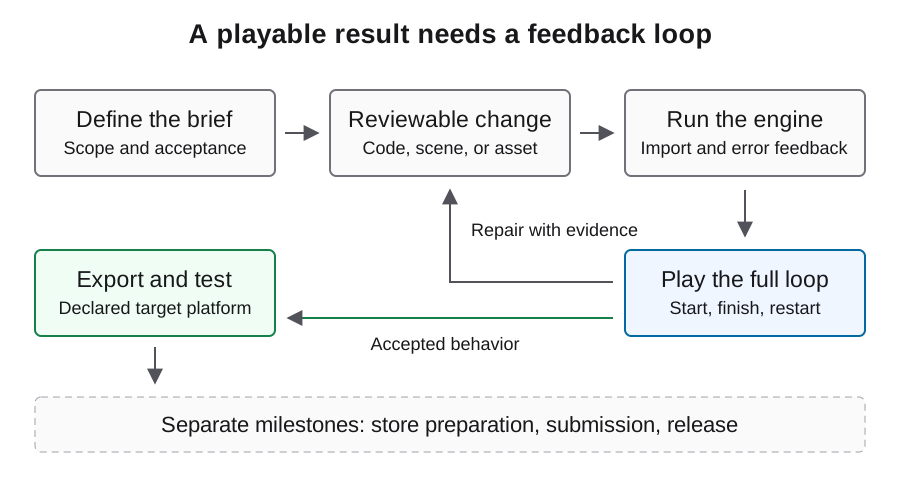
A playable demo demonstrates a small experience. An export is a generated deliverable. A tested export has been exercised on its target system. Steam submission means a package has been sent for platform review, and release means the product is live. Keep all five states distinct in development notes and public claims.
This distinction is useful operationally: the next owner can see whether the missing work is gameplay, packaging, disclosure, or platform review. A model-generated executable filename is not evidence of any later state. Start the release checklist from an artifact a reviewer can actually launch.
| Milestone | Evidence to retain |
|---|---|
| Playable demo | Observed complete loop and source identity |
| Export | Artifact and build log |
| Tested export | Target-OS acceptance record |
| Submission | Submitted build and store-record identity |
| Release | Verified public product state |
Schedule platform requirements independently
Steam onboarding describes a 30-day wait after the app fee for the first few titles and at least two weeks with a publicly visible Coming Soon page. Identity, tax, bank, and review work also precede release. Read the official onboarding page for the applicable account and current requirements before setting a date.
Treat these as gates in a schedule, not values to hide inside development time. A one-day coding experiment cannot promise a new-account Steam release. Record when each gate actually starts and clears; do not invent a guaranteed launch date by adding approximate processing estimates.
Prepare a reviewer-ready build package
Keep the target artifact, build identity, launch instructions, controls, and known limitations together. Test startup from a clean user state and complete the core loop. Exercise save and relaunch behavior so a reviewer is not dependent on a developer's existing machine state.
Steam's review process checks the store presence and build. Internally, reconcile the features described in store copy with what the submitted artifact provides. If multiplayer, controller support, a language, or a mode has not been tested, resolve the claim before submission. A clear package makes failures actionable rather than merely producing a rejected checklist item.
Classify the actual AI contribution
Steam's Content Survey distinguishes development-efficiency tooling from AI-created content shipped to and consumed by players. It separates pre-generated content from live-generated content; the latter requires describing safeguards against illegal output. Review the current survey against the actual product rather than using a blanket label based on the coding assistant.
Build an internal inventory of where each tool contributed: implementation assistance, shipped artwork, sound, narrative, localization, or runtime output. Have the product owner resolve ambiguous cases against the survey before submission. The inventory supports accurate answers; it is not a substitute for the platform's questions or review.
Reconcile assets, permissions, and marketing
For each distributed asset, retain its origin, permission basis, modifications, attribution requirements, and final file identity. Include fonts, sound effects, voice work, and material embedded in screenshots. A generated file can still contain material that needs review, and an engine or tool license does not cover every input.
Compare store imagery with the tested build. Use actual gameplay captures for claims about the game experience, and do not present concept art as proof of implemented features. If a license or ownership question remains unresolved, assign an owner and keep that asset out of the approved release package until it is resolved.
Keep store localization aligned with the game
Review translated store copy against the same feature inventory as the source language. Preserve control terminology, platform support, accessibility statements, and content descriptions. A translator should not turn a planned feature into a shipped one or imply language support the build does not contain.
Track store text, interface strings, subtitles, and audio as separate review surfaces. Test the game in each advertised configuration and keep evidence tied to the build. The localization guide covers identifiers, formatting arguments, and UI checks; use Steam's localization documentation for the store-specific workflow before changing public records.
Treat runtime AI as a service dependency
If the game calls a model while players use it, evaluate service access, failure handling, privacy, abuse controls, and ongoing spend as a separate product system. Ordinary offline game logic does not create model requests just because an assistant wrote the code.
For a runtime feature, define what happens when the service is unavailable or a budget limit is reached. Keep provider secrets out of the distributed client. Resolve the applicable Steam requirements for live-generated content and service monetization using the current official documentation. Development API consumption and game sales are different measurements and should not be presented as interchangeable.
Create a submission handoff with open issues
Before requesting publishing authorization, summarize the exact build, store materials, asset review, survey answers, required account steps, and unresolved defects. Assign a person to each open issue and record the evidence needed to close it. Do not let a completed checklist conceal an untested target platform.
After submission, preserve the actual status and reviewer feedback. Approval is not the same event as release, and a released product still needs an operational check. This guide summarizes official documentation rather than providing legal clearance or a guaranteed schedule. Recheck the applicable requirements before submitting the exact build and store materials you intend to release.
FAQ
Can a new developer publish a Steam game in one day?
Do not promise that. Steam documents applicable onboarding waits, Coming Soon presence, and review gates independently of how quickly a game is coded.
Is using a coding assistant automatically the same as shipped AI artwork?
No. Review the contribution by category against the current Content Survey, particularly whether content is shipped to and consumed by players.
Does disclosure guarantee acceptance?
No. Survey completion does not replace content rules, rights review, or build and store review.
Is an exported game ready for submission?
It first needs target-platform acceptance, accurate store materials, rights records, and the applicable account and survey requirements.
Does this guide provide legal clearance for assets?
No. It provides a recordkeeping workflow and links to platform requirements. Obtain qualified review for unresolved rights or contractual questions.
What changes when the game generates content during play?
Review live-generation safeguards, service access, ongoing costs, and the applicable Steam requirements separately from development-time assistance.