Make money with AI games on Steam
Updated 2026-09-05
Turn an idea into a game people want to buy. Use coding agents for production, then build a commercial plan around players, a credible release, net receipts and ongoing support.
Choose a product with a reason to buy
Start with a player and a purchase reason: a compact puzzle game with a distinctive rule, a replayable challenge, or a specific experience an existing audience already seeks. Define the promise that can appear on a store page, then decide which features are necessary to deliver it. A smaller coherent product gives you a clearer budget and a more testable sales proposition.
Review comparable games to understand presentation, player expectations and complaints. Treat their reviews and prices as market research, not a formula for your own revenue. Before building a large content library, show a playable slice to potential players and record whether they understand the appeal and want to return.
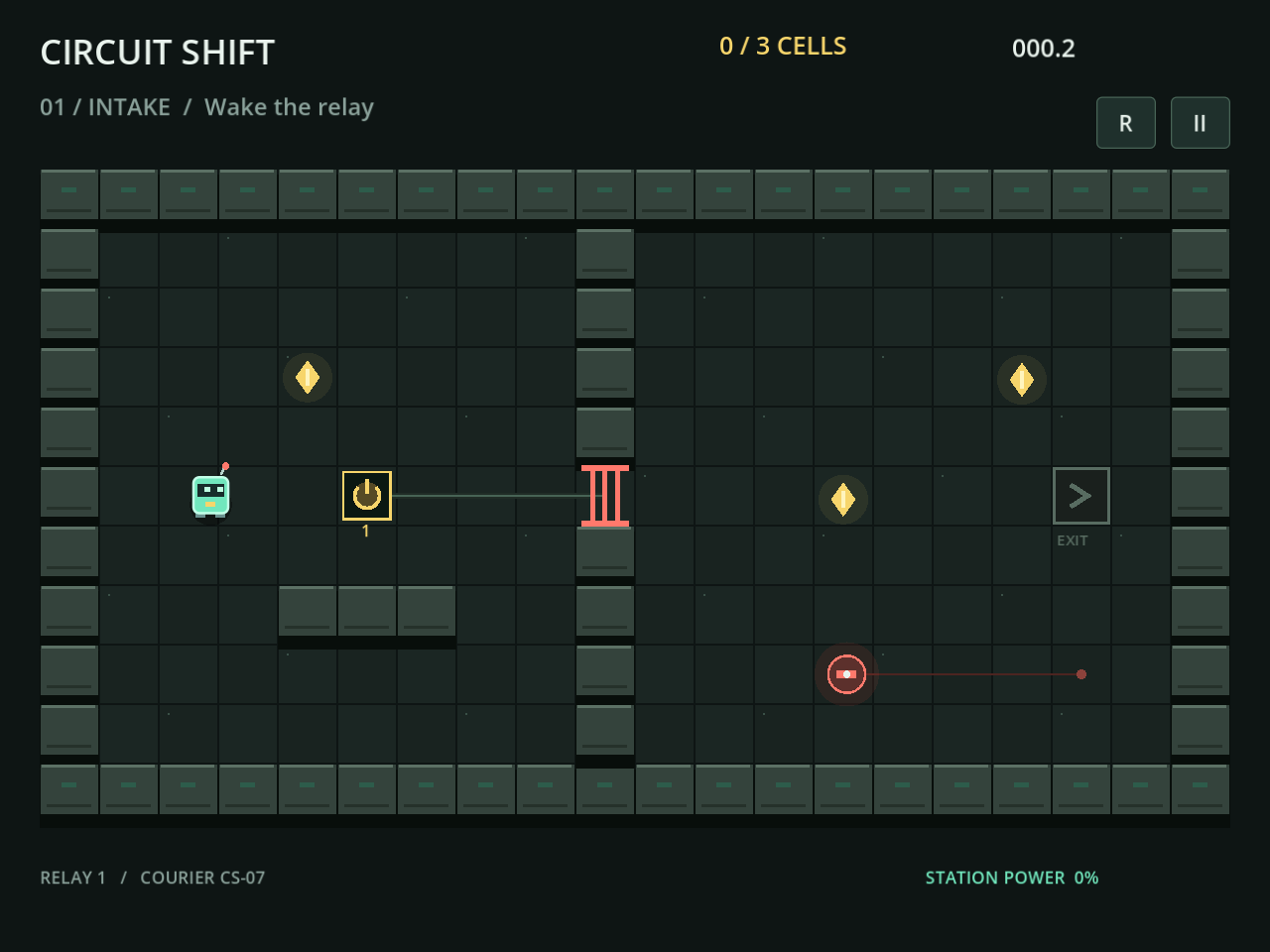
Use Astra or another coding agent to build the first slice
The Circuit Shift case shows a bounded development result: an Astra-configured Codex task produced a three-room native Godot prototype with collisions, relay puzzles, failure and restart, settings, and saved progress. Its recorded wall time was about 24 minutes 20 seconds with an existing engine available. The original brief, screenshots, source project and checks are available in the separate case study.
Use that as a production example, then estimate the work your commercial concept still needs: onboarding, content depth, accessibility, platform testing, store materials and support. Give the agent observable player tasks and a test command. Retain review and repair time in the budget; rapid prototype creation is only one part of bringing a paid game to market.
Select a revenue model before expanding the scope
For a conventional small game, a paid base product is a straightforward starting point to evaluate. Its development API usage belongs in the project budget; ordinary gameplay does not automatically create model requests. Additional content is a separate product decision that should follow the experience and audience, rather than compensate for an unfinished base game.
A game with live AI characters has different economics because player activity can incur ongoing inference, translation or audio charges. Steam's content-survey guidance discusses managing that access and using Steam-supported payment methods. Budget usage, concurrency, safety controls and service continuity before promising ongoing access to customers.
| Business shape | What customers buy | Cost to validate |
|---|---|---|
| Paid base game | A complete playable experience | Development, launch and post-release support |
| Additional content | A clearly described extension | Production and maintenance of that extension |
| Live AI gameplay | Ongoing model-enabled interactions | Per-player service usage, access controls and support |
Plan the actual Steam release path
Steam Direct currently requires a $100 USD or equivalent fee per new app. The fee is not refundable; the documented recoupment condition is at least $1,000 in Adjusted Gross Revenue, with repayment recorded separately. Verify the applicable taxes and account requirements when budgeting your launch.
For the first few titles, Steam documents a 30-day wait after paying the app fee and at least two weeks with a public Coming Soon page. Store and build review also require time. Run store preparation alongside production, keep the page consistent with the delivered game, and complete the content survey accurately. Use the detailed Steam guide for the operational checklist and current official links.
Build demand through a demo, a clear page and relevant outreach
Prepare screenshots and a short trailer that show the player's actual actions and the game's distinctive appeal. Use a demo or a controlled playtest to learn where people lose interest, then improve the game and its presentation together. Reach communities and creators whose audiences already care about the genre; a broad list of unrelated contacts provides little evidence of demand.
Track store visits, wishlists, purchases, refunds and player feedback as separate stages. Steam provides wishlist reporting and notification features, but a wishlist is not a paid order. Use your own observed conversion after launch for planning future work. Do not forecast sales by multiplying a generic internet conversion rate by a wishlist count.
Calculate the sales needed to recover the budget
Use developer receipts after platform deductions, not the store sticker price, when building a break-even model. Steam's financial documentation distinguishes gross revenue, adjustments, net revenue and the contractual revenue-share payment. Reconcile your own reports and keep income taxes, banking effects and the value of your time visible rather than assuming the payment is personal profit.
The table is an illustrative scenario, not a Steam forecast or reported game result. Assume $1,200 of project cash costs and $6 of developer receipts per sale after platform deductions, with no additional per-player service cost. Break-even is 200 sales. Track any app-fee recoupment separately when it is actually recorded.
| Assumed paid copies | Assumed developer receipts | Receipts less $1,200 cash budget |
|---|---|---|
| 100 | $600 | -$600 |
| 200 | $1,200 | $0 |
| 300 | $1,800 | $600 |
contribution_per_sale = developer_receipts_per_sale - variable_service_cost_per_sale
break_even_sales = ceil(fixed_project_cost / contribution_per_sale)
project_contribution = paid_sales * contribution_per_sale - fixed_project_cost
# Break-even is undefined when contribution_per_sale <= 0.
Learn from a published AI-game business account
In the Vaudeville Early Access postmortem, developer Simone Odoardi reported that the studio grew from a part-time solo operation to two full-time developers. He described AI-service costs as manageable relative to Steam revenue, while explaining that payment timing required a cash buffer and that one voice service became too expensive. This is attributed developer experience, not audited profit data or an Astra/APIsRouter result.
The useful commercial lesson is to evaluate both profitability and cash timing. A project can attract paying players while creating bills before the corresponding platform payout arrives. Keep development spend, recurring services, refunds and support in the same operating plan, and revisit assumptions when actual player behavior differs from the budget.
Improve the business after the first sales
Review buyer feedback, refund reasons, completion behavior and support effort after release. Prioritize improvements that strengthen the promised experience, then evaluate localization or additional content against observed demand and production cost. Keep versioned builds and a manageable update process so sales do not create an unsustainable support burden.
For API budgeting, record development requests separately from any live-player usage. Use the applicable provider's current model catalog and prices, set project budgets, and reconcile actual usage. The existing technical guides explain engine workflows, asset handling, localization and API accounting; this page supplies the commercial plan that those workflows support.
FAQ
Can an AI-assisted game be submitted to Steam?
Steam has a documented review and content-survey process for games that use generative AI. A submission must satisfy the current content rules and distribution agreement; completing the survey does not guarantee acceptance.
Can I make and sell a game in one day?
A small prototype may be built quickly, but release preparation, platform requirements, player testing and finding customers are separate work. New Steam releases can also face the documented waiting periods.
How many copies do I need to sell?
Divide the fixed project budget by positive contribution per sale and round up. Use developer receipts after platform deductions and subtract variable player-service costs; replace all example inputs with your own figures.
Does every player consume my development API budget?
Not for ordinary exported gameplay. A live AI feature creates a separate operating cost, which needs its own access, usage and monetization design.
Is Circuit Shift an example of Steam income?
It is a documented native development prototype. No Steam release, customer sales or revenue were observed; its code and test evidence support the development case only.
Where should I start?
Choose a narrow audience and product promise, build a small playable slice, test it with relevant players, and prepare a budget and store plan before expanding the production scope.