Make money with AI ecommerce
Updated 2026-09-05
Earn through orders that retain a contribution margin or a catalog service merchants pay for. Connect AI-assisted content to an offer, accepted delivery and a complete cost ledger.
Choose who pays and what they receive
A merchant earns from fulfilled orders after product, acquisition and operating costs. A service business earns fees for accepted catalog cleanup or localization. The first needs demand and positive order economics; the second needs a merchant with a backlog and budget.
Sell an inspectable outcome: accurate product information in a target language, resolved variant inconsistencies, or an approved catalog package. Revenue begins when a buyer purchases the product or pays for the work.
Measure order profit instead of gross sales
Shopify's gross-profit-by-product report subtracts recorded product cost from net sales and depends on cost information present at sale. WooCommerce's Revenue Report separates sales, returns, coupons, taxes and shipping. Neither a sales total nor product gross profit alone answers what the business keeps after all its expenses.
For your worksheet, subtract discounts and refunds from gross merchandise sales, then product cost, fulfillment, payment fees, acquisition and variable content costs to obtain contribution. Subtract allocated fixed overhead to estimate net order profit before income tax. Reconcile tax and shipping collections separately; include API compute and review explicitly.
Work through a synthetic order worksheet
This synthetic USD illustration assumes 100 orders with identical average economics, no separate shipping collections and sales tax excluded. It is not a customer result or forecast. The content allowance covers API compute and review, not a model tariff.
Gross sales are $6,000, contribution is $1,220, and net order profit before income tax is $820 after $400 allocated overhead. Higher sales with higher acquisition or return costs can leave less money. Recalculate for each actual cohort.
| Synthetic average order | Amount |
|---|---|
| Gross merchandise sale | $60.00 |
| Discounts and refunds | -$6.00 |
| Net merchandise sales | $54.00 |
| Product cost | -$22.00 |
| Fulfillment | -$6.00 |
| Payment fees | -$1.80 |
| Customer acquisition | -$10.00 |
| Allocated API compute and retries | -$0.40 |
| Allocated human content review | -$1.60 |
| Contribution per order | $12.20 |
| Allocated fixed overhead | -$4.00 |
| Net order profit before income tax | $8.20 |
Sell a bounded catalog localization offer
Target a Shopify or WooCommerce merchant preparing products for another language, with source facts and an approval owner. Offer a paid pilot covering named SKUs, one locale, specified fields, a glossary, validation report and one correction round. Agree deadlines and acceptance after inspecting the source.
Show a permitted sample, then quote the batch. Charge for reviewed deliverables, not promised sales uplift. Offer recurring product maintenance after an accepted delivery establishes buyer demand.
Price the service around delivery margin
A separate synthetic service example assumes a $600 batch fee, $45 aggregate API compute including retries, $150 language QA, $120 of your production time and $35 sales and payment costs. The remaining $250 is service contribution before fixed overhead and income tax, not take-home pay. These assumptions are not market rates or provider prices.
If language QA doubles to $300, contribution falls to $100. Define correction limits, source-change charges and payment milestones in the offer. Count prospecting and unpaid revisions too: a profitable-looking delivery can lose money when acquisition time or rework is omitted.
Make QA part of the paid deliverable
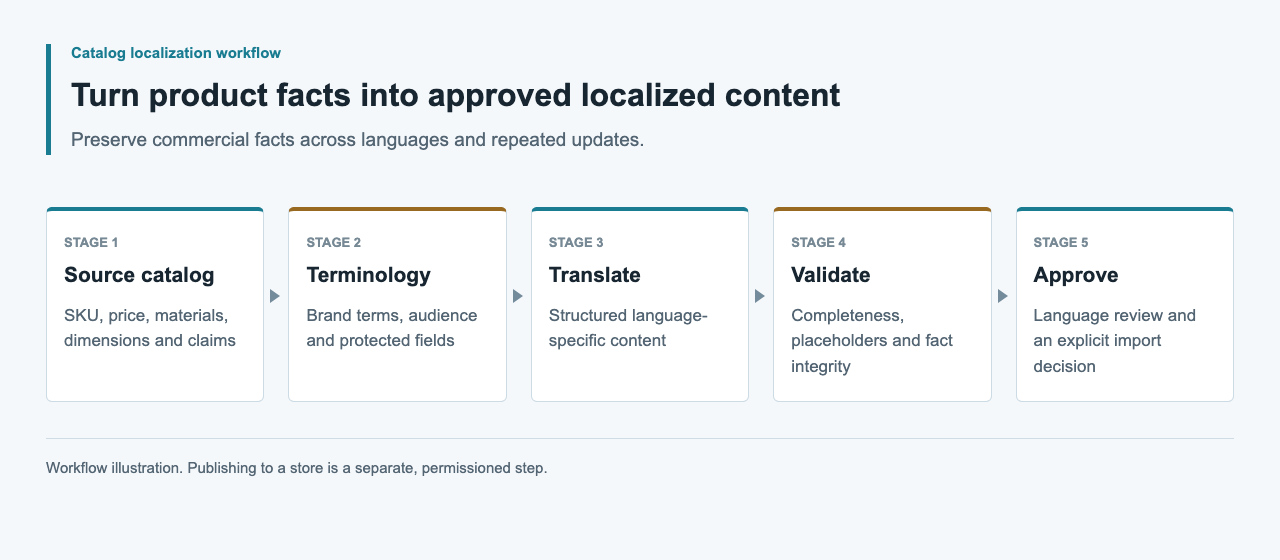
Preserve source facts and keep SKU, price, currency, dimensions and variant relationships outside editable model output. Have a qualified language reviewer check meaning and a merchant approve product claims. Deliver the source revision, localized candidates, issue report, approval record and destination-specific import package. Agree who owns publication and read-back checks; preparation is not permission to change a live store.
The customer can inspect completed checks and blocked products before accepting. Include review costs in the quote.
Use the catalog case as proof of workflow skill
The linked catalog-localization case uses 20 synthetic products and 40 Japanese/German drafts from Luna. Its structural checks and review artifacts show a way to preserve fields and inspect candidates. Native-speaker and merchant semantic review remain pending. It is not an Astra test, customer-sales result or evidence of conversion uplift.
Use it to explain your deliverables. Separate demonstrations from accepted client work and commercial results. Follow the catalog, product-quality and platform guides for implementation.
Expand from accepted work and measured contribution
For a store, test a bounded product and locale cohort, track attributable orders and contribution, and allow time for returns. A before-and-after sales difference can reflect promotions, seasonality or traffic changes; use a suitable comparison before claiming content caused uplift.
For a service, track accepted batches, cash collected, rework hours and contribution by customer. Expand with repeat demand and delivery capacity. Check current API pricing and reconcile actual costs. Start with a costed pilot, named buyer and approval owner.
FAQ
Can I earn without owning a store?
A fee-based catalog or localization service can target merchants with an existing backlog. Income requires a paying buyer and accepted work; a generated sample is only portfolio material.
Is ecommerce revenue the same as profit?
No. Net order profit subtracts the relevant costs and allocated overhead. Contribution is an intermediate measure before fixed overhead; state the income-tax boundary.
What should a first paid offer include?
Specify products, locale, editable fields, review responsibilities, delivery date, correction allowance and acceptance criteria. Quote source cleanup separately when its scope is unknown.
Does the 20-product case prove more sales?
No. It demonstrates structural handling of synthetic catalog drafts from Luna, with semantic review pending. It contains no observed orders, sales uplift or Astra result.
How should I budget AI usage?
Estimate the complete batch including retries and compute, check current pricing, and reconcile actual usage. Add reviewer and production time before deciding the fee or margin.