Make money with AI trading
Updated 2026-09-05
The goal is net strategy profit after trading, data, API compute and review costs. Start with a testable edge and a break-even budget, then validate the economics before committing risk capital.
Start with the profit hypothesis
Making money with AI trading requires an economic edge that survives costs. AI-assisted research is an input, not evidence of earnings. Define net strategy profit as trading profit or loss minus execution friction, data, API compute, infrastructure and human review. State whether taxes are included.
Begin with one question: could a repeatable feature extracted from information available at the time improve a predefined strategy versus its baseline? Write down the comparison, measurement window and rejection conditions before asking an agent to search for supporting evidence.
Give AI a job that can improve the economics
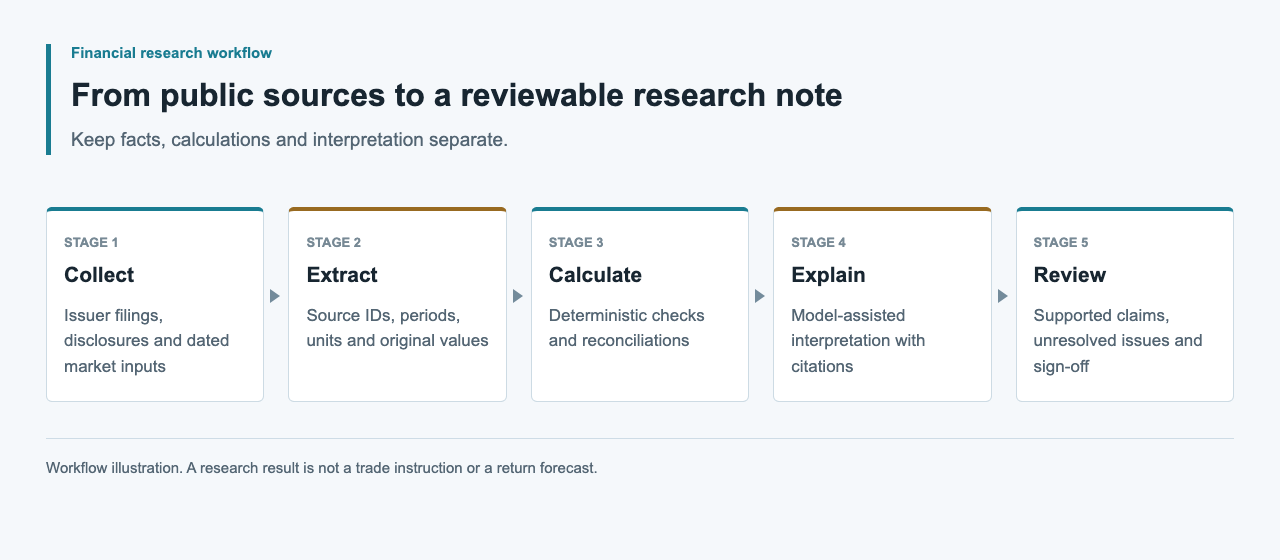
Use AI to extract disclosure fields, reconcile earnings explanations against filings, or identify missing evidence. Each accepted result needs its source and timestamp. Compare against a simpler baseline, including reviewer time and correction rates.
The question is whether extra analysis changes a measurable decision enough to justify its expense. Lower research costs can improve a viable workflow; predictive value needs separate evidence. Our stock-analysis, financial-statement and TradingAgents guides cover implementation.
| Possible source of economic value | AI-assisted work | Evidence needed |
|---|---|---|
| Information processing | Extract comparable event fields from many dated filings | A predefined decision improves versus the baseline after costs |
| Lower workflow cost | Reuse verified extraction and target difficult review questions | Savings persist after corrections, human review and data fees |
| Decision consistency | Apply documented rules and record deviations | A reproducible comparison; consistency alone does not establish a trading edge |
Calculate the gross hurdle before estimating income
This synthetic monthly worksheet illustrates costs only, not observed performance or a model tariff. Assume 40 completed round trips, with $5 of combined commissions, spread and slippage per round trip. Assume unleveraged positions without borrowing or financing charges; add those costs whenever applicable.
The research subtotal is $300 and execution friction is $200, so gross trading profit must exceed $500 merely to produce positive net strategy profit before tax. No gross profit is assumed or observed. Replace every input with measured usage, actual invoices and reviewed execution estimates.
| Synthetic monthly input | Calculation | Cost |
|---|---|---|
| Data and infrastructure | Assumed budget | $120 |
| API compute, including retries | Assumed aggregate usage cost | $60 |
| Human review | 4 hours x $30 | $120 |
| Execution friction | 40 round trips x $5 | $200 |
| Total pre-tax break-even hurdle | $120 + $60 + $120 + $200 | $500 |
Spend the research budget on falsifiable tests
Freeze the hypothesis, signal construction, decision timing and cost assumptions. Split development data from an untouched out-of-sample period. Preserve unsuccessful candidates and count all experiments, so one attractive result cannot hide an expensive search. Historical inputs must reflect when information became available, including revisions and missing companies.
Evaluate whether the proposed benefit persists under worse friction and different periods. Compare net outcomes with the predefined baseline using the same assumptions. Repeatedly tuning against the holdout turns it into development data. Set a research spending limit and stop when evidence no longer justifies another iteration.
Keep hypothetical, paper and live results distinct
An out-of-sample backtest is historical simulation. Paper trading observes a workflow against arriving data with simulated orders. Live trading exposes actual capital to fills, losses and operational failures. Each answers a different question; progression is a separate decision, not an automatic consequence of a passing test.
NFA Interpretive Notice 9025 explains limitations of hypothetical performance, including hindsight, liquidity, slippage and behavior under financial risk. Its promotional requirements concern specified NFA Members and Associates, not every reader worldwide. The practical lesson here is to label evidence precisely and never present simulation as money earned.
Treat risk capital as separate from operating cash
Research expenses consume cash regardless of strategy performance. Risk capital faces market losses and remains separate from operating budgets. Any later live decision needs an independently reviewed loss budget, exposure limits and an owner able to suspend execution. Essential living expenses and business operating cash should remain outside that experiment.
Investor.gov identifies AI claims of guaranteed high returns with little risk as fraud warning signs. This page offers an evaluation framework, not security recommendations. A credible profit thesis remains a hypothesis until the relevant evidence exists; losing money remains possible.
Improve net economics before increasing activity
Track cost per accepted research artifact, including retries and corrections. Reuse reviewed source extracts when current, reserve expensive analysis for unresolved questions, and compare total task cost using current API pricing and actual usage.
For any separately authorized live operation, reconcile broker statements, positions and expenses. Separate realized profit from unrealized marks, and exclude deposits from earnings. More trades increase friction; more agents increase expense. Expand against predefined evidence and review criteria.
Choose the next step by the missing profit evidence
Use the quantitative research guide to define a hypothesis, the financial-statement workflow to improve extraction, and the cost guide to budget an experiment. Choose the step that resolves the largest uncertainty about net profitability.
The deliverable is a reviewed hypothesis, reproducible evaluation and complete cost account. Keep workflow improvements and investment income separately measurable, with evidence for each.
FAQ
Can AI trading make money?
It may support a profitable strategy, but this page establishes no such result. Profitability depends on an independently tested edge, execution and complete costs, not the AI label.
How much can I earn each month?
There is no supported monthly income estimate here. The $500 illustration is a cost hurdle, not an earnings target, expected return or observed result.
Does a profitable backtest justify live trading?
No. It is hypothetical evidence under assumptions. Out-of-sample review, paper behavior and any separately authorized live operation have different evidentiary limits.
Which costs belong in net strategy profit?
Include execution friction, applicable financing, data, infrastructure, API compute and human review. Declare the tax boundary and avoid counting a cost twice.
What should I budget first?
Budget a bounded research evaluation and reviewer time. Model usage is an operating expense; it does not require an investment deposit or authorize trading.