Ecommerce localization from catalog to storefront
Updated 2026-09-05
Treat language, product facts and market operations as separate decisions. Build a glossary, review each locale, and check the stored content in its storefront context.
Separate translation from market readiness
Translation changes how a fact is expressed. Localization also asks whether a reader can understand the product, interpret its measurements and find the relevant service information. Market readiness goes further: someone must confirm the actual delivery, payment, return and product rules. A fluent page cannot establish those operational facts.
Make a scope sheet for each locale. Identify the language reviewer, category reviewer and store owner. Record which policies remain unresolved and assign the next action. Start with a buyer journey your team can support end to end, then expand the language inventory as review capacity becomes available.
Inventory the buyer journey
Start with the path a buyer follows: product discovery, variant selection, specification reading, cart review and service information. Include navigation labels, size guidance, image text and error messages when they affect that path. Translating descriptions alone may leave critical decisions in another language.
Assign each content surface to its real owner and storage location. A theme label, product field and policy document may require different tools. Keep the inventory connected to source revisions so a later product update can identify which translations need review rather than forcing the team to rediscover every dependent sentence.
| Surface | Main reviewer question | Evidence to keep |
|---|---|---|
| Product text | Are facts complete and understandable? | Source-linked approved revision |
| Variant selectors | Can the buyer select the intended item? | Label and variant mapping |
| Campaign copy | Is the approved message appropriate here? | Market brief and approval |
| Service policies | Does wording match actual operations? | Policy-owner approval |
| Store interface | Does the locale render coherently? | Viewport and navigation checks |
Define locale identifiers deliberately
W3C guidance explains how BCP 47 tags distinguish language and, where useful, script or region. Use a language tag that matches the intended content and the destination platform's supported values. Do not invent a locale code just because it looks like a country abbreviation.
For your own records, keep the content locale separate from the target market and currency. The same language can be used in multiple markets with different commercial settings. Make fallback behavior explicit: a missing translation should be identifiable during review, not silently counted as a completed locale because the source language appeared instead.
Build a glossary around product meaning
For each important term, write a short definition and the product context in which it applies. Add approved target forms, brand names that remain unchanged and examples of misleading alternatives. Give the reviewer a way to request an exception instead of forcing a technically wrong glossary term into every sentence.
Version the glossary and attach that version to each candidate. A changed term should trigger a review of affected content. W3C ITS provides a reference for marking terminology and translation-related metadata; the lightweight record below is an illustrative editorial format, not an ITS implementation or a store import schema.
{
  "conceptId": "material-linen",
  "definition": "Fiber described as linen in the approved specification",
  "sourceTerm": "linen",
  "targetLocale": "de",
  "approvedTerm": "Leinen",
  "rule": "Do not infer a material blend or certification",
  "reviewStatus": "pending"
}
Protect prices, units and product claims
A localized decimal separator is a display choice; it is not permission to change a stored amount. Keep the source price, currency and unit values in a protected record. If conversion is needed, make it a separately approved deterministic operation with the conversion rule recorded.
Apply the same discipline to claims. A phrase such as suitable for travel must not become an unsupported durability guarantee. Require evidence for materials, compatibility, certifications and health-related assertions. Preserve uncertainty from the source, and flag missing specifications for the product owner rather than letting the model complete an attractive story.
Review each locale in two passes
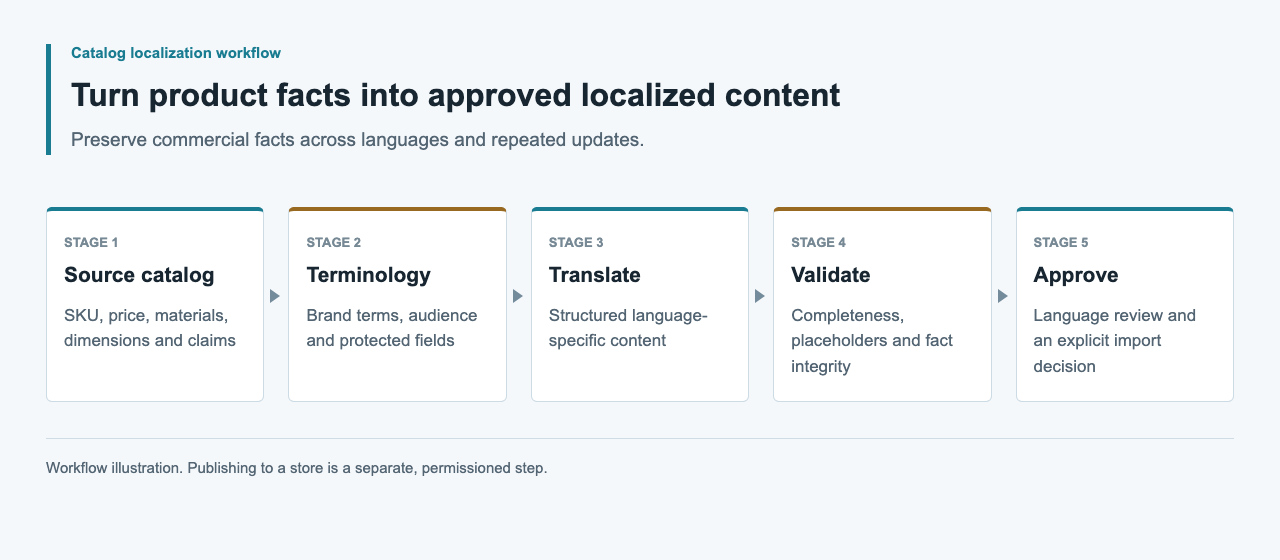
Use a fact pass and a language pass. The first compares quantities, units, product relationships and claims against the source. The second considers terminology, natural expression, audience and brand tone. Record each result independently so readable copy cannot hide an unresolved factual defect.
Review the full product context, including warnings and variant labels, not isolated strings alone. For unfamiliar or regulated categories, involve an appropriate specialist. A model-generated back-translation can help locate differences, but agreement between generated texts is not independent proof that either one matches the product.
Prepare destination-specific delivery
Shopify distinguishes translation management from the broader act of presenting localized store content in its merchant documentation. Use the platform's language workflow and verify which resources are supported. In another store stack, confirm the multilingual layer and its import contract before mapping any locale columns.
Create a delivery package with product identifiers, locale, source revision, approved text and reviewer identity. Keep that review package separate from the minimal import payload. In a staging store, check language selection, fallback, text wrapping, links and product selection. Content that exists in an export is not necessarily visible on the intended page.
Keep localization current after launch
Track source changes at field level. A corrected material statement should invalidate the affected translations even if the title stays the same. An updated glossary may require a targeted terminology review; a price change should flow through the commercial data path rather than rewriting every description.
Measure coverage as current, approved product-locale revisions, and report held or stale records separately. Track API spend, reviewer effort and storefront behavior independently. Use the catalog workflow to define those records, then review the backlog by product importance and source freshness before expanding coverage.
FAQ
Is localization the same as translation?
Translation is one component. Localization also checks context and presentation, while commercial readiness requires confirmation of actual store operations and product rules.
Should a locale always include a country code?
Use the specificity that the content needs and the platform supports. Keep market targeting separate so a language tag does not become an accidental proxy for currency or shipping eligibility.
Can AI convert dimensions during translation?
Keep conversion out of the language step. When authorized, apply a recorded conversion rule and verify both the number and its unit before approval.
How should brand names be handled?
Record approved treatment in the glossary. Preserve names by default within this workflow, and have the brand owner approve any market-specific rendering.
When is a locale ready to publish?
After source-current content passes factual and language review, the destination import is verified, and storefront checks confirm the intended content and product behavior.