Astra for ecommerce: a catalog experiment
Updated 2026-09-05
Evaluate whether Astra can produce useful multilingual product content while preserving facts. This draft defines the experiment; case results are awaiting evidence.
Test the work that needs judgment
Use Astra on questions whose difficulty comes from context: a product term with multiple meanings, a description that must preserve a qualification, or a brand voice that needs a natural local expression. Keep copying SKUs and formatting import files in deterministic code.
OpenAI documents GPT-6 Astra for complex reasoning and professional workflows. A practical ecommerce experiment should test that capability against your own acceptance rules. Ask whether the resulting copy is acceptable and how much correction it needs, rather than assuming a model's general capability establishes catalog accuracy.
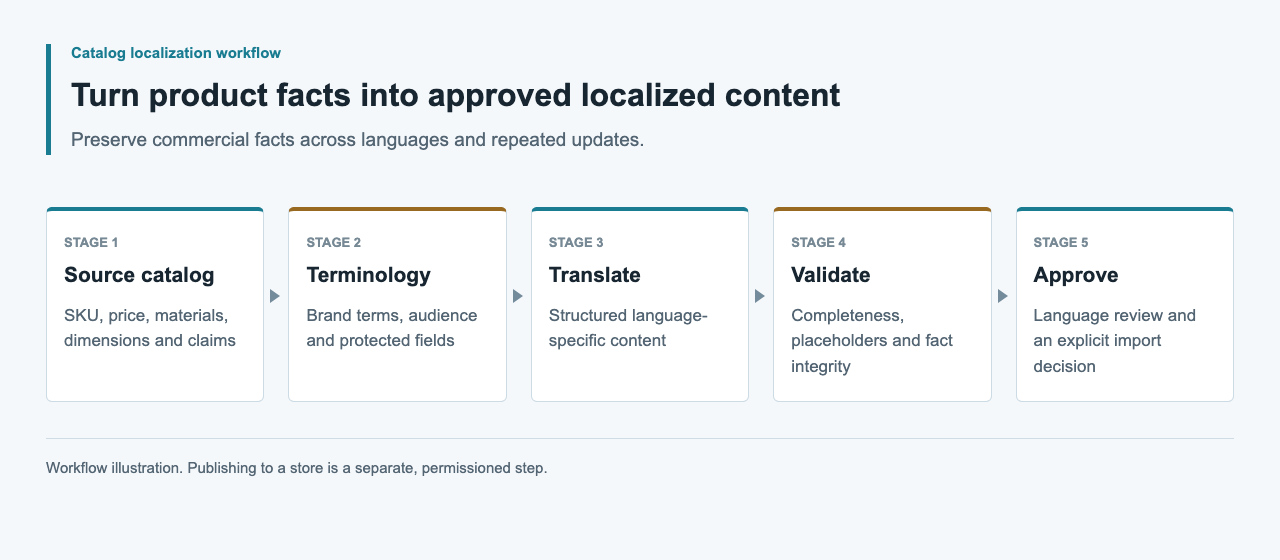
Define the sample before running it
The proposed sample contains 20 self-owned or synthetic SKUs with English, Japanese and German target versions. That is a test design, not a processed catalog. Include distinct variant relationships, missing facts, protected brand terms, measurements and at least one ambiguous source statement.
Use the same source snapshot and glossary for every candidate. Decide which fields are required and what counts as an acceptable description before seeing output. Record the source rights and keep real customer data out of the experiment. The sample is intended to expose errors, not to represent every product category or market.
Freeze the task and approval contract
Ask for localized text and a separate issue list. Prohibit changes to SKU, price, currency, units and variant identity. Keep unsupported claims out of the draft and require a review issue when a specification is missing. Preserve source references so the reviewer can check the product rather than the model's confidence.
The template below is an illustrative task contract. It can be used to prepare a future controlled run, with model settings and actual access recorded separately. Keep any human follow-up instructions as part of the experiment history instead of folding them invisibly into the initial request.
Inputs: fixed source catalog, glossary revision, locale brief.
For each product-locale pair, propose title and description.
Use only supported facts; retain qualifications and care warnings.
Return review issues separately from public copy.
Do not edit SKU, price, currency, measurement units or variant IDs.
Do not write to a store or publish any page.
Keep every candidate associated with its source revision.
Compare drafting and review roles fairly
Evaluate Astra as a drafter and as a reviewer in separate experimental arms if access permits. Hold the source, glossary and acceptance rules constant. A stronger review step is useful only if it catches relevant defects without creating new unsupported changes.
For a comparison model, record the exact available ID and use the same sample. Keep model identity hidden from editorial reviewers where practical. Count accepted product-locale revisions and correction categories, then inspect the difficult cases individually. Do not declare a winner from one attractive paragraph or from response length.
| Role under test | Controlled input | Observable outcome |
|---|---|---|
| Description drafter | Approved source and glossary | First-pass defects and accepted revision |
| Translation reviewer | Fixed candidate and source facts | Useful findings and incorrect objections |
| Revision assistant | Recorded reviewer instructions | Corrections and newly introduced defects |
Separate automated checks from human judgments
Run exact comparisons for protected fields and source revisions. Check required output fields, identifier coverage, placeholder counts and parsable markup. A schema-valid result should advance to editorial review, not directly to import.
Have product and language reviewers assess claims, omissions, terminology and natural expression. Record each correction with the original candidate and the accepted version. Treat unresolved facts as held work. If a reviewer manually rewrites the copy, retain that intervention so the result is not presented as an untouched model output.
Verify the import package in a test store
Prepare an import proposal from source-current, approved candidates. Use a test WordPress/WooCommerce environment and confirm its actual multilingual storage contract before mapping the target languages. Keep the source export and previous field values available for comparison.
After an authorized test import, save the import report and compare stored text, SKU, price and units with the approved package. Inspect the storefront locale and variants. Capture real test screenshots with the environment labeled. A generated CSV, a model answer and a stored multilingual catalog are different deliverables; the experiment should identify which ones were achieved.
Keep a cost and intervention ledger
Record model identity, access path, request attempts, input and output usage, available cache details, request charges and manual revision time. Keep failed or interrupted requests in the record when their usage is known. Unknown usage should remain empty with a reason rather than becoming zero.
Report API spend per accepted product-locale revision only when the ledger is complete enough and at least one revision is accepted. Keep subscription-based work separate from API charges and identify the actual provider used. Compare the full task cost with the editorial burden, not only the cost of the first generation.
Evidence status and access limits
GPT-6 Astra officially exists. The September 5, 2026 public APIsRouter catalog snapshot did not list it, and this article does not establish gateway Astra access. A future run must record the actual authorized access path and model identity; work performed through an official OpenAI product must be attributed to that product.
This case remains evidence-blocked: the 20-SKU run, multilingual outputs, reviewer decisions, usage ledger and verified store import are not available. There are no case results to report. Publication as a completed case requires those artifacts, including failed checks and human interventions, followed by source and editorial review.
FAQ
What should Astra do in a catalog workflow?
Evaluate context-heavy drafting or review, such as ambiguous terminology and qualified claims. Keep identity preservation and import assembly in deterministic steps.
Why use a fixed sample?
A fixed sample makes differences attributable to the tested configuration more interpretable. Include difficult records and use the same acceptance criteria for every candidate.
How should manual corrections be counted?
Retain the initial candidate, reviewer instructions and accepted revision. Classify corrections and record time where measured so human work remains visible in the result.
How can the comparison avoid favoring one model?
Keep source, glossary and tasks constant, and conceal model identity from editorial reviewers where practical. Compare accepted work and defects under the same rubric.
What is the current case status?
The experiment is defined but evidence-blocked. Consult the evidence section for the missing run and access records before treating it as a completed case.