Codex Astra usage limits and paid continuation
Updated 2026-09-05
First identify the account and allowance that stopped the task. Then choose a documented continuation path with its own billing, access and feature boundaries.
A limit message is an account signal, not a model verdict
Reaching a Codex allowance does not mean Astra has disappeared or that another API account has the same remaining capacity. Start by checking whether the current session uses ChatGPT login or an API key. OpenAI documents these as separate authentication and billing paths for local work.
The official pricing guide says ChatGPT Work and Codex share usage. It also distinguishes included allowances from additional credits and API-key usage. The same task can encounter different controls depending on where it runs and how it is authenticated. Identify the affected allowance first, then choose whether to wait, use eligible credits or continue locally with API-key billing.
Read your dashboard and the active CLI session
Use the official Codex usage dashboard for current limits and reset times. During an interactive Codex CLI session, /status shows remaining limits. Separately, codex login status identifies the active authentication method. Record the selected account or workspace before interpreting the numbers, especially when you use more than one organization.
The pricing page's message ranges are estimates, not a fixed promise of Astra turns. Local messages and cloud chats share the plan allowance, and weekly limits may also apply. A dashboard observation is specific to that account and time. Do not turn a screenshot from another plan or a published estimate into a countdown for your own task.
codex login status/statusWhy similar prompts can consume different allowances
OpenAI identifies model choice, task complexity, context, reasoning, tools, retrieval and caching as usage factors. A short instruction can start a large repository inspection or a long tool loop, while a longer self-contained question may require less work. Prompt length alone is therefore an unreliable predictor.
To understand your own pattern, keep task outcomes alongside the usage observations: what source material was included, which model was selected, and whether the task needed repeated revision. Compare similar accepted tasks rather than counting messages in isolation. Try narrowing irrelevant context or selecting a smaller suitable model, then compare the result and usage with the original task. Keep the same completion criteria so a shorter but unfinished answer does not look like an improvement.
Compare the documented continuation choices
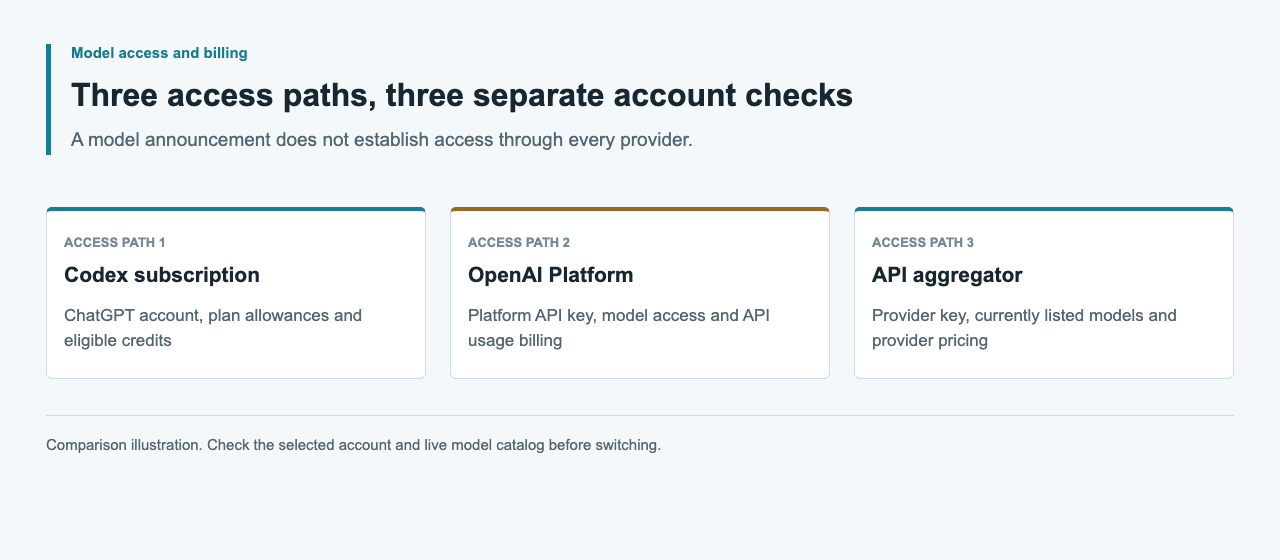
The official pricing guide offers more than one path. Plus and Pro users can purchase additional credits when they reach included limits. Eligible Business, Enterprise and Edu workspaces can use additional workspace credits under their pricing arrangement. Users may also run extra local work with an API key at API rates.
Choose based on the task's required surface, features and billing owner. Waiting for the displayed reset preserves the current account path. Changing the model may help when capacity remains and the work suits it. API-key work is separately metered; it is not a mechanism for bypassing API limits or converting an existing subscription into unlimited usage.
| Choice | Accounting path | Check first |
|---|---|---|
| Wait for reset | Current plan allowance | Dashboard reset time and active window |
| Use a smaller suitable model | Current plan allowance | Remaining capacity and task requirements |
| Additional personal credits | Eligible ChatGPT plan credits | Offer and terms shown for your account |
| Additional workspace credits | Eligible workspace pricing | Administrator policy and agreement |
| Extra local API-key work | OpenAI Platform API usage | Model access, rates and feature support |
Continue local work with an intentional auth change
Before changing login mode, preserve the task's working files, accepted decisions and remaining checks. OpenAI supports local API-key authentication in the desktop app, CLI and IDE extension; Codex cloud requires ChatGPT login. For a task moving from cloud to local work, prepare the local checkout, dependencies and required integrations before continuing.
For the CLI, supply your own OPENAI_API_KEY through stdin using the command below, then confirm login status. Review custom provider settings before sending work and select the model available to your key. CLI and extension credentials can be shared, so check both if you use them together. Model work in this mode incurs charges under your OpenAI Platform account at API rates.
printenv OPENAI_API_KEY | codex login --with-api-key
codex login status
Distinguish subscription exhaustion from API errors
An API-key request can still fail because of credentials, model access, rate pressure, prepaid credit exhaustion or enforced spend limits. These are Platform controls, not the Codex subscription reset clock. Inspect structured API errors and the relevant project settings rather than assuming every limit has the same remedy.
OpenAI's error guide distinguishes credit_balance_exhausted, project_spend_limit_exceeded and organization_spend_limit_exceeded from request-rate errors. Retrying a billing or spend-limit error does not restore access. For rate pressure, follow Retry-After when present and pace requests. Keep logs redacted and retain the error code; the visible phrase used by an application may omit the distinction that actually determines what to do next.
| Limit surface | Authoritative check | Decision |
|---|---|---|
| ChatGPT-authenticated Codex | Usage dashboard; CLI /status | Reset, eligible credits or task adjustment |
| API request rate | API error and rate-limit headers | Reduce pace and retry within bounds |
| API prepaid balance | credit_balance_exhausted; Platform billing | Review funding before more requests |
| API spend limit | Structured spend-limit code; account settings | Obtain a budget decision |
Provider availability and evidence: September 5, 2026
The continuation paths in this guide come from official Codex pricing and authentication documentation. No live account transition was performed for the article. The APIsRouter public pricing check on September 5, 2026 returned HTTP 200, success: true and 34 models, with no Astra or GPT-6 entry.
An APIsRouter balance does not replenish ChatGPT allowances, and this catalog observation establishes no Astra continuation route. Use the live catalog to inspect current offerings. For a different provider, check its model identity, supported protocol and billing terms separately; subscription credits and Codex workspace features do not transfer with an endpoint change.
Resume with a budget and a clear completion test
Once the account path is chosen, restate the next concrete milestone: a reviewed code change, a validated document or another observable output. Check whether unfinished work is still running before starting a duplicate task. Preserve previous artifacts so the new attempt does not silently repeat expensive work.
Record the new authentication mode, model and usage evidence separately from earlier subscription activity. For API work, set an approved task budget and bounded retry policy, then reconcile recorded usage after completion. The official guide allows an active turn to continue after a usage limit is reached subject to fair use; it does not promise that every task finishes or that the next turn has capacity.
FAQ
How many Astra messages do I get in Codex?
There is no universal fixed count. The official pricing page gives estimates affected by model, task complexity and execution context. Check your usage dashboard and CLI /status for current limits and resets.
Can I buy extra usage without changing my plan?
The official guide documents additional credits for Plus and Pro and additional workspace credits for eligible flexible-pricing plans. Check the offer and policy for your account.
Does API-key usage spend my subscription allowance?
OpenAI API-key mode uses Platform API billing instead of included ChatGPT plan credits. Its own model access, rate limits and billing controls still apply.
Will API-key login preserve every Codex feature?
No. Local API-key work is documented, but features that rely on ChatGPT workspace access or cloud services can be limited or unavailable. Codex cloud requires ChatGPT authentication.
Can an APIsRouter top-up restore my Astra limit?
No. It does not replenish ChatGPT allowances. Astra was also absent from the September 5, 2026 APIsRouter catalog check; consult the live catalog for current offerings.